
Essential Cross Stitch Tools List for Beginners in 2026
Discover the essential cross stitch tools list for beginners in 2026. Equip yourself with the right supplies to start your stitching journey!
Essential Cross Stitch Tools List for Beginners in 2026
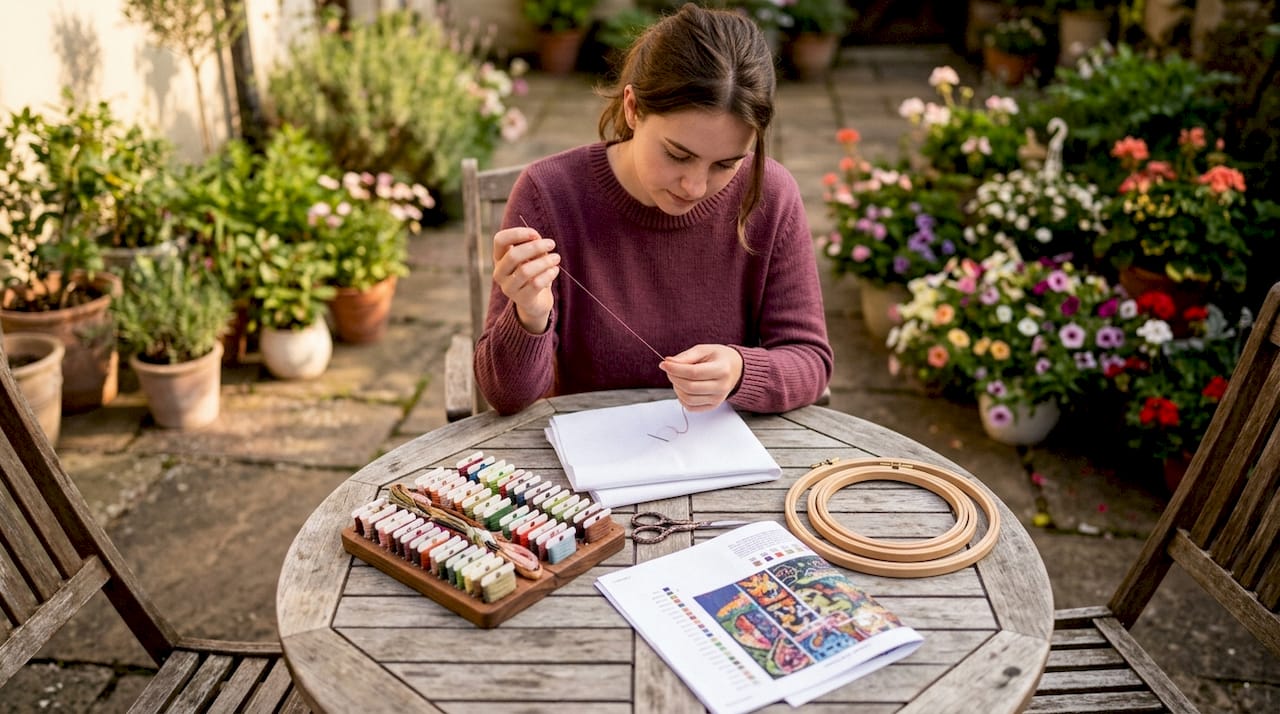
An essential cross stitch toolkit is defined as the six core supplies that make stitching possible: fabric, floss, needles, scissors, a pattern, and a hoop. Together, these form the foundation every beginner needs before picking up a needle. Starter kits typically cost between $25 and $40 and include all six components in one purchase. Good lighting is the one accessory experts recommend adding from day one, since it prevents counting errors and reduces eye strain before they become a problem.
1. The essential cross stitch tools list: fabric first
The right fabric makes every other tool work better. 14-count Aida cloth is the industry standard for beginners because its woven grid creates 14 clearly visible holes per inch. That structure makes counting stitches straightforward and keeps your work even from the first row.
Aida comes in counts ranging from 11 to 28, but 14-count hits the sweet spot between visibility and stitch density. Higher counts like 18 or 28 require finer needles and sharper eyesight. Start at 14-count and move up only when you feel ready. For a deeper look at how fabric choices affect your project, the Flossom fabric guide covers every skill level in detail.
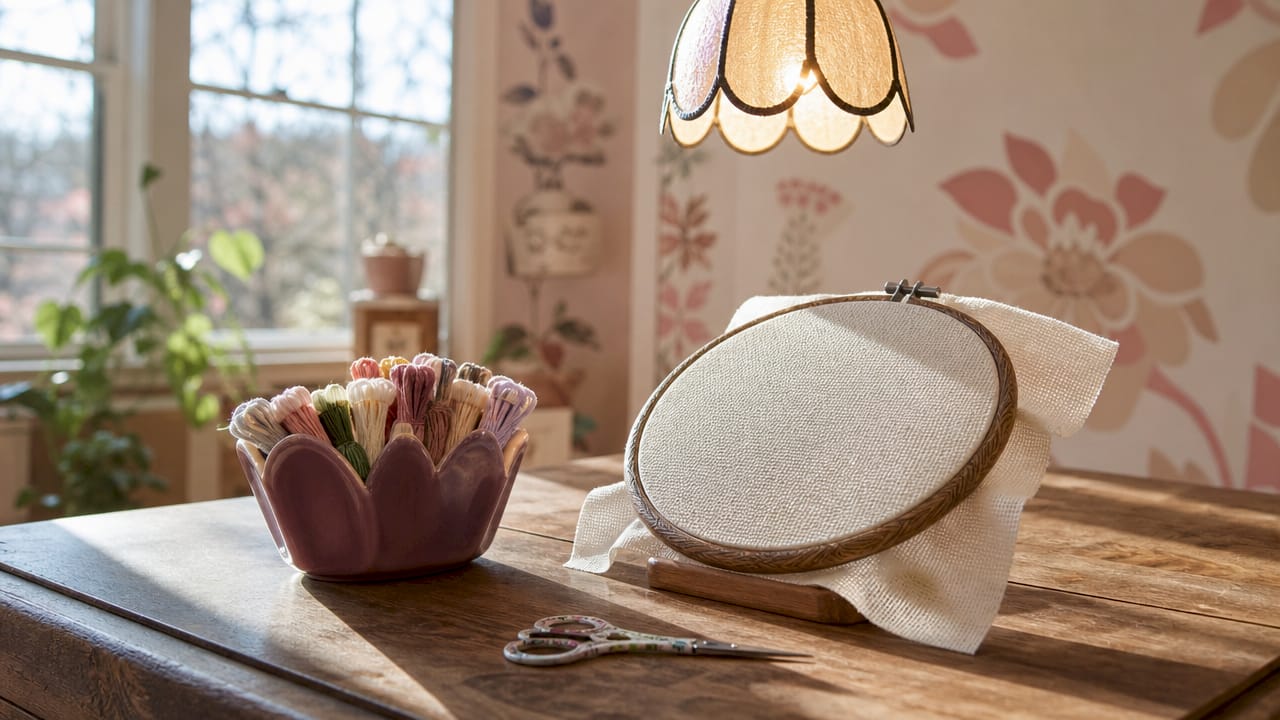
Pro Tip: Buy white or cream 14-count Aida for your first project. Dark fabric hides the holes and makes counting much harder when you are still learning.
2. Embroidery floss: the thread that defines your work
DMC is the gold standard thread brand for cross stitch, offering over 500 colorfast color options that resist fading through washing and handling. Colorfast thread matters because a project that bleeds or fades after one wash is a project wasted. DMC stranded cotton floss separates into six individual strands, and most cross stitch on 14-count Aida uses just two strands per stitch.
Key facts about embroidery floss for beginners:
- Stranded cotton is the most common floss type and the easiest to work with
- Two strands on 14-count Aida gives clean, full coverage without bulk
- DMC and Anchor are the two most widely available brands at craft stores
- Colorfast quality means the thread holds its color through washing
Thread storage matters more than most beginners expect. Loose skeins tangle fast. Wind your floss onto plastic bobbins and label each one with its DMC color number. Organizing your thread stash from the start saves hours of untangling later.
Pro Tip: Never cut your entire skein into lengths at once. Cut one working length of about 18 inches at a time to reduce knots and thread wear.
3. Needles: size and tip matter more than you think
Cross stitch uses tapestry needles, not sharp embroidery needles. Tapestry needles have a blunt tip that slides through the Aida holes without splitting the fabric threads. Size 24 or 26 tapestry needles are the correct match for 14-count Aida. Using a needle that is too large distorts the holes; one that is too small makes threading difficult.
What to look for in a cross stitch needle:
- Blunt tip to prevent splitting fabric weave
- Large eye for easy threading with two strands of floss
- Size 24 or 26 for standard 14-count Aida fabric
- Nickel-plated or gold-plated finish for smooth, snag-free stitching
Needles are inexpensive and last a long time if stored properly. A small needle case or a piece of felt keeps them organized and prevents rust. Needle minders are magnetic devices that hold your needle on the fabric when you set your work down. They are a small purchase that prevents the frustrating experience of losing a needle in a couch cushion.
Pro Tip: Buy a pack of assorted tapestry needle sizes. As you move to higher-count fabrics, you will already have the right needle on hand.
4. Scissors: one pair for fabric, one for thread
Sharp scissors are non-negotiable in cross stitch. Dull blades fray thread ends and make it impossible to cut cleanly close to the fabric. Most stitchers keep two pairs: small embroidery scissors with fine, pointed blades for trimming thread tails, and a larger pair for cutting fabric to size.
Features that make scissors ideal for embroidery work:
- Fine, pointed blades for cutting close to the fabric surface
- Sharp edges that cut cleanly without fraying
- Compact size (3–4 inches) for precision control near stitching
Never use your embroidery scissors on paper or tape. Paper dulls blades faster than almost anything else. A dedicated pair of small scissors kept only for stitching will stay sharp for years.
5. Hoops and frames: keeping fabric taut
Fabric tension directly affects stitch quality. Loose fabric causes uneven stitches and makes counting harder. A hoop or frame holds the fabric taut so each stitch sits flat and consistent.
The three main tension tools each have a different use case:
| Type | Best for | Main advantage | Main drawback |
|---|---|---|---|
| Wooden hoop | Beginners, small projects | Affordable, widely available | Can crease fabric over time |
| Q-Snap frame | Medium projects | No hoop marks, easy to reposition | Slightly higher cost |
| Scroll frame | Large or long-term projects | Best tension, no distortion | Bulkier to store and use |
Frames like Q-Snap and scroll frames reduce fabric creasing that wooden hoops can cause on longer projects. The choice between hoop and frame affects both fabric tension and how your finished piece looks. A wooden hoop in a 6-inch or 8-inch size is the right starting point for most beginners. You can always upgrade to a Q-Snap or scroll frame once you take on larger designs.
6. Patterns: your stitching roadmap
A cross stitch pattern is a grid chart where each symbol or color block represents one stitch. Without a pattern, there is no project. Beginners should start with patterns under 100 x 100 stitches. Projects at that size typically take 6–15 hours to complete, which is roughly three to four evenings of stitching. That time frame is short enough to stay motivated but long enough to build real skill.
Printed patterns are easier to mark up with a pencil as you stitch. Digital patterns work well on a tablet if you use a PDF reader that lets you zoom in. Free pattern libraries, like those available through Flossom, offer beginner-friendly designs at no cost.
7. Needle threaders: a small tool with a big payoff
Threading a needle with two strands of floss is harder than it sounds, especially under dim light. A needle threader solves this in seconds. The tool consists of a thin wire loop that you push through the needle eye, thread your floss through the loop, then pull back through. The whole process takes about five seconds.
Needle threaders cost less than a dollar each and come in multi-packs. Keep two or three on hand because the wire loop breaks with heavy use. This is one of the cheapest tools on the cross stitch supplies checklist and one of the most used.
8. Floss organizers: tame your thread collection
A tangled thread collection slows down every project. Plastic bobbins wound with individual floss colors and stored in a divided box keep everything visible and accessible. Once a stitcher owns upward of 50 colors, a proper organization system stops being optional and becomes necessary.
Label each bobbin with the DMC color number using a permanent marker or printed sticker. Store bobbins in numerical order so you can find any color in seconds. For a practical system that scales as your collection grows, the Flossom guide on organizing thread skeins walks through several approaches used by experienced stitchers.
9. Lighting: the tool most beginners skip and regret
A dedicated daylight lamp is considered a must-have tool by experienced stitchers. Standard room lighting distorts thread colors and makes counting holes on Aida much harder than it needs to be. Daylight bulbs with a high color rendering index (CRI of 90 or above) show thread colors accurately and reduce the eye fatigue that builds up over a long stitching session.
Good color rendering in your lighting also prevents a specific and frustrating mistake: stitching with the wrong color because two similar shades looked identical under warm yellow light. A clip-on daylight lamp costs around $20–$40 and pays for itself the first time it saves you from ripping out a completed section.
Pro Tip: Position your lamp to the left if you are right-handed, or to the right if you are left-handed. This prevents your stitching hand from casting a shadow over your work.
10. Building your kit on a budget
Beginners often overspend on large kits filled with tools they will not use for months. The smarter approach is to buy only the absolute essentials first and add accessories as specific needs arise.
A practical starter checklist:
- Fabric: One piece of 14-count Aida, at least 4 inches larger than your pattern on each side
- Floss: Only the colors your first pattern requires, in DMC or Anchor
- Needles: A pack of size 24 or 26 tapestry needles
- Scissors: One small pair of sharp embroidery scissors
- Hoop: One 6-inch or 8-inch wooden hoop
- Pattern: One beginner design under 100 x 100 stitches
- Needle threader: Two or three in a multi-pack
Needles, scissors, and hoops are reusable across dozens of projects. The only recurring cost is fabric and floss. Focusing on the absolute essentials keeps your first investment low and lets you decide which accessories actually improve your personal stitching experience before spending more.
Key Takeaways
The six core cross stitch supplies are fabric, floss, needles, scissors, a pattern, and a hoop. Every other tool supports these basics rather than replacing them.
| Point | Details |
|---|---|
| Start with 14-count Aida | This fabric is the easiest for beginners to count and stitch on accurately. |
| Use DMC or Anchor floss | Both brands offer colorfast quality and are available at most craft stores. |
| Match needle size to fabric | Size 24 or 26 tapestry needles are correct for standard 14-count Aida. |
| Add lighting early | A daylight lamp prevents color errors and reduces eye strain from the first session. |
| Buy only what you need | A $25–$40 starter kit covers all six essentials without unnecessary extras. |
What I actually tell every new stitcher
Most beginners ask me which tools to buy first. My honest answer surprises them: buy less than you think you need.
I have watched new stitchers spend $80 on a kit full of specialty scissors, magnetic boards, and thread conditioners before they have finished a single project. Then they get frustrated because the kit feels complicated, not the craft. Limiting your initial toolkit and mastering basic stitches with quality fabric and thread builds confidence faster than any accessory collection.
The two tools I tell every beginner to add in the first month are a daylight lamp and a needle minder. The lamp changes everything about accuracy. The needle minder saves your sanity. Everything else can wait until a specific project demands it.
The one technique tip I give more than any other: make all your stitches cross in the same direction. That single habit separates clean, professional-looking work from messy work. No tool in the world fixes inconsistent stitch direction.
As your collection grows past 50 thread colors, that is when organization tools earn their place. A good floss management system and a digital tool like Flossom to track what you own will save you from buying duplicates and hunting for missing colors mid-project.
— Simone
Flossom makes your toolkit work harder
Once your physical tools are in place, keeping track of what you own is the next challenge. Flossom is a cross stitch companion app that catalogs your thread and fabric stash, compares it against your pattern needs, and auto-generates a shopping list for only what you are missing.
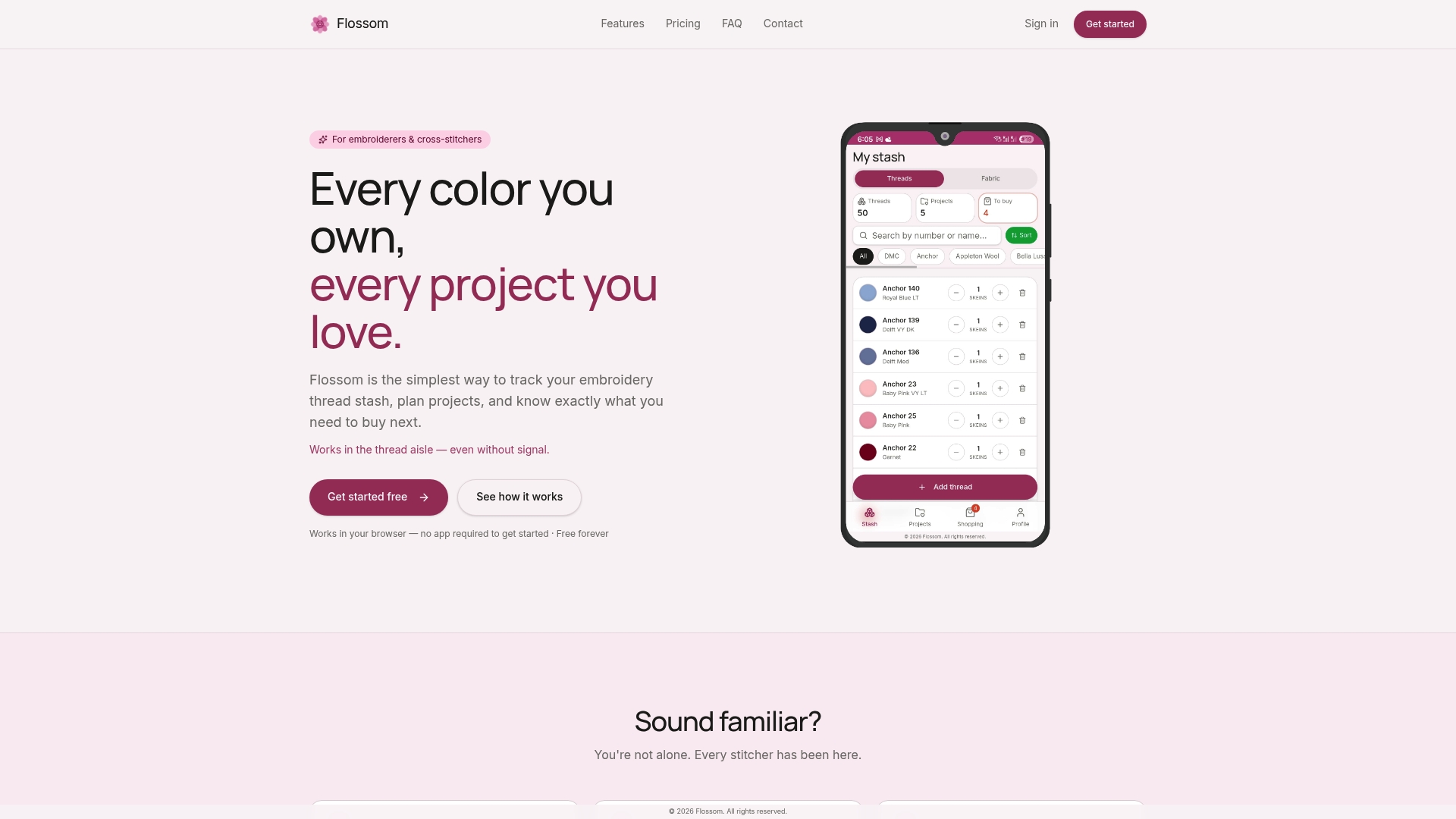
The free tier covers DMC and Anchor catalogs with unlimited stash entries and up to three active projects. Before you start your next project, use the Flossom project time calculator to estimate how many hours it will take. You can also browse the free pattern library for beginner-friendly designs ready to stitch. Flossom works in any browser and installs to your home screen on iOS, Android, and desktop.
FAQ
What are the six essential cross stitch supplies?
The six core supplies are fabric, embroidery floss, tapestry needles, scissors, a pattern, and a hoop or frame. A starter kit containing all six typically costs between $25 and $40.
What fabric should a beginner use for cross stitch?
14-count Aida cloth is the standard beginner fabric because its visible grid makes counting stitches straightforward. It works best with size 24 or 26 blunt-tipped tapestry needles.
How many strands of floss do you use for cross stitch?
Most cross stitch on 14-count Aida uses two strands of stranded cotton floss. DMC stranded cotton separates into six individual strands, so you pull two from the skein for each stitch.
Do I need a hoop to do cross stitch?
A hoop or frame keeps fabric taut, which directly improves stitch consistency and makes counting easier. Wooden hoops work well for small projects; Q-Snap or scroll frames are better for larger designs.
What is the best way to organize cross stitch floss?
Wind each color onto a labeled plastic bobbin and store bobbins in a divided box sorted by DMC number. This system becomes necessary once your collection grows past 50 colors.
Recommended
We make Flossom — the calm app for cross-stitchers and embroiderers who want their stash, projects, fabric and shopping list in one tidy place.