Cross Stitch Fabric Types Explained for Every Skill Level
Discover cross stitch fabric types explained for every skill level. Learn how to choose the right fabric for your projects and improve your stitching!
Cross Stitch Fabric Types Explained for Every Skill Level
Cross stitch fabric is defined by its weave structure, fiber content, and thread count, and these three factors determine everything from stitch clarity to finished size. The three primary fabric categories are Aida, evenweave, and linen. Each suits a different skill level and project style. Understanding cross stitch fabric types explained in full means knowing not just what each fabric looks like, but how it behaves under a needle, how it affects your finished dimensions, and which backing and needle choices complete the picture. Flossom's fabric size calculator makes the math fast once you know your fabric.
What are the main cross stitch fabric types explained?
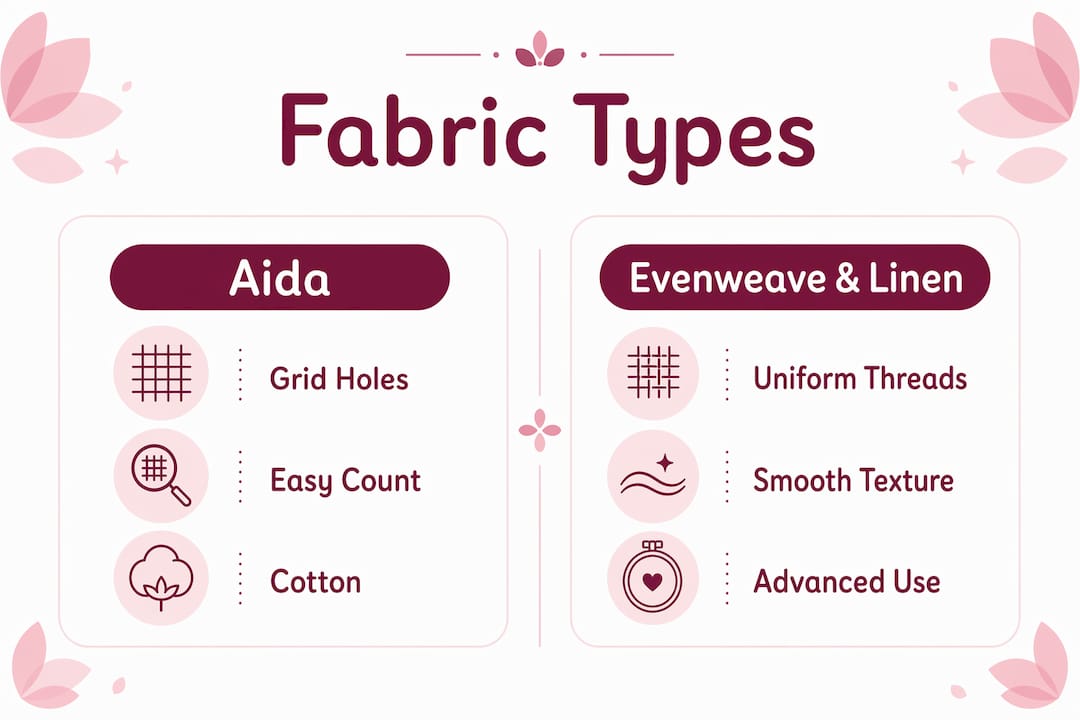
Aida, evenweave, and linen are the three fabric types every cross stitcher needs to understand. Each one has a distinct weave structure, fiber makeup, and ideal use case. Getting this foundation right saves you from buying the wrong material for your project.
Aida is a block-weave evenweave made from 100% cotton with clearly defined square holes between woven blocks. Evenweave fabrics typically blend cotton and viscose for a smoother, more uniform surface. Linen is 100% flax fiber with natural thread thickness variations that give it a distinctive, slightly irregular texture.
The weave structure is what separates these fabrics most visibly. Aida's grid of holes makes counting stitches straightforward. Evenweave and linen require you to count individual threads rather than holes, which demands more attention but rewards you with a finer finish.
What defines Aida fabric and when should you use it?
Aida is the standard starting point for new stitchers, and for good reason. Its block-weave construction creates a visible grid that makes stitch placement obvious. You push your needle through a hole, cross to the opposite hole, and the fabric guides every move.
Common Aida counts and what they mean
Aida comes in counts ranging from 11 to 18 stitches per inch. The count number tells you how many stitches fit in one inch of fabric.
- 11-count Aida produces large, bold stitches. It works well for children's projects, quick gifts, and stitchers with limited vision.
- 14-count Aida is the most popular count. It balances stitch visibility with design detail and suits most beginner patterns.
- 16-count Aida gives a slightly finer result without demanding the precision of higher counts.
- 18-count Aida produces small, detailed stitches and suits intermediate stitchers ready to move beyond the basics.
Aida is available in dozens of colors, from white and cream to black, navy, and seasonal shades. This variety lets you choose a background that complements your design rather than fighting it.
One limitation worth knowing: Aida's stiff block-weave makes fractional stitches and backstitches harder to place cleanly. The needle must force through the woven block rather than glide between threads. For designs heavy in quarter or three-quarter stitches, evenweave or linen will give you cleaner results.
What are evenweave fabrics, and how do Lugana and Jobelan compare?
Evenweave fabrics are woven with a single thread in each direction, creating a consistent, uniform surface without the raised blocks of Aida. The result is a smoother finish that suits polished, full-coverage designs. Lugana and Jobelan are the two most widely used evenweave fabrics in cross stitch.
Lugana
Lugana is a 52% cotton and 48% viscose blend woven at 25 or 28 count. The viscose content gives it a subtle sheen and a soft drape that Aida cannot match. Stitchers working on large, detailed pieces favor Lugana because the fabric lies flat and handles well over long sessions.
Jobelan
Jobelan uses a similar cotton-viscose blend and comes in counts from 25 to 32. It has a slightly heavier hand than Lugana and holds its shape well under tension. Both fabrics are available in a wide range of solid and hand-dyed colors.
Key characteristics of evenweave fabrics:
- Counts range from 25 to 40, producing finer stitches than most Aida options.
- Stitching over two threads is the standard technique, which effectively halves the count. A 28-count evenweave stitched over two threads behaves like 14-count Aida.
- Fractional stitches sit cleanly because the needle glides between individual threads rather than forcing through a block.
- The surface finish is more refined, making evenweave the preferred choice for pieces destined for framing or gifting.
Evenweave fabrics offer a consistent, professional appearance that suits stitchers who want their finished work to look polished rather than textured. The learning curve is real but manageable after one or two projects.
What makes linen the choice for advanced cross stitchers?
Linen is woven from 100% flax fiber, and that origin gives it qualities no cotton or cotton-blend fabric can replicate. The natural variation in flax thread thickness means linen has a slight irregularity in its weave. That irregularity is not a flaw. It is the source of linen's characteristic warmth and traditional appeal.
Linen counts typically run from 25 to 40 per inch. Like evenweave, linen is almost always stitched over two threads. The thread variation means you must count carefully, and the holes are less obvious than on Aida or evenweave.
Key characteristics of linen:
- Natural thread variation creates a lively, organic texture that suits botanical, folk art, and heirloom designs.
- Higher counts (32–40) produce extremely fine work with a delicate, antique quality.
- Linen softens with washing, making it a practical choice for functional items like table linens and pillowcases.
- The fabric breathes well and ages gracefully, which is why museum-quality embroidery is often worked on linen.
Pro Tip: Wash and press linen before you stitch on it. Linen shrinks more than cotton, and pre-washing prevents your finished piece from distorting after completion.
The stitching experience on linen is different from Aida. You must develop a feel for finding the correct holes, especially on fine counts. Most stitchers recommend starting with 28-count linen before moving to 32 or higher.
How does fabric count affect finished project size?
Fabric count is defined as the number of stitches per inch, and it directly controls how large your finished design will be. The calculation is simple: divide your design's stitch count by the fabric count to get the finished dimension in inches.
A design 140 stitches wide on 14-count Aida finishes at 10 inches. The same design on 18-count Aida finishes at 7.8 inches. That is a meaningful difference when you are planning a frame or a gift.
| Fabric count | Design width (140 stitches) | Finished size |
|---|---|---|
| 11-count | 140 ÷ 11 | 12.7 inches |
| 14-count | 140 ÷ 14 | 10 inches |
| 18-count | 140 ÷ 18 | 7.8 inches |
| 28-count (over 2) | 140 ÷ 14 | 10 inches |
| 32-count (over 2) | 140 ÷ 16 | 8.75 inches |
Always add at least 2 inches of extra fabric on all sides beyond your calculated design area. Failing to leave adequate margin makes hooping and framing difficult and risks distorting the pattern area near the edges.
Pro Tip: Use Flossom's fabric size calculator to enter your stitch count and fabric count and get the exact fabric dimensions you need, including the recommended margin.
How do you choose the right needle and backing fabric?
The right needle protects your fabric. The right backing protects your finished work. Both choices depend on the fabric type you are using.
Needle selection by fabric type
Size 24 tapestry needles suit 14-count Aida and are the standard recommendation for beginners. Tapestry needles have blunt tips that glide between threads without splitting them.
- 11-count Aida: size 22 tapestry needle
- 14-count Aida: size 24 tapestry needle
- 18-count Aida or 28-count evenweave: size 26 tapestry needle
- 32-count and above: size 28 tapestry needle
Linen introduces a debate. Blunt tapestry needles protect the weave, but sharp chenille needles allow more precise piercing on fine linens where the holes are less defined. Many experienced linen stitchers keep both types on hand and switch based on the fabric count and stitch type.
Backing fabric and stabilizer choices
Backing choice directly affects project durability. Woven fabrics like Aida and linen generally need only a removable tear-away stabilizer during stitching if any backing is used at all. Stretch fabrics require a permanent cut-away stabilizer to prevent distortion.
For framing finished pieces, the backing material matters long-term. Acidic materials like standard cardboard cause yellowing and fiber degradation over time. Archival, acid-free foam or mount boards preserve your work for decades. If you are framing a piece you want to last, acid-free backing is non-negotiable.
Key Takeaways
The fabric you choose determines your finished size, stitch quality, and how long your work lasts.
| Point | Details |
|---|---|
| Aida suits beginners | Its block-weave grid makes stitch placement obvious and counting straightforward. |
| Evenweave gives a polished finish | Lugana and Jobelan produce cleaner fractional stitches and a more refined surface. |
| Linen offers heirloom quality | Its natural flax texture and aging properties make it ideal for traditional and keepsake pieces. |
| Fabric count controls finished size | Divide your stitch count by fabric count to calculate design dimensions before you buy. |
| Backing material affects longevity | Use acid-free mount boards for framing to prevent yellowing and fiber decay over time. |
What I've learned from stitching on every fabric type
The most common mistake I see is treating fabric choice as a progression from beginner to advanced. Stitchers move from Aida to linen because they want a different result, not because linen is better. A bold, graphic design on 11-count Aida can look exactly right. The same design on 32-count linen would lose its impact entirely.
My honest advice: choose your fabric based on what the finished piece needs to look like, not on what feels like the next level up. If you want a warm, textured, traditional feel, linen is the answer. If you want a clean, consistent surface for a modern geometric design, Lugana or Jobelan will serve you better. Aida is not a stepping stone. It is a legitimate choice for the right project.
The detail that trips up most stitchers moving to evenweave or linen for the first time is the margin. They calculate the design area correctly but forget that proper fabric margins are necessary for hooping and framing. Cut generously. You can always trim. You cannot add fabric back.
One more thing: do not skip the needle swap when you change fabrics. Using a size 24 needle on 32-count linen will enlarge the holes and distort the weave. The right needle costs almost nothing and makes a visible difference in the finished work.
— Simone
Plan your next project with Flossom
Knowing your fabric type is the first step. Knowing exactly how much fabric to buy is where most projects go sideways.
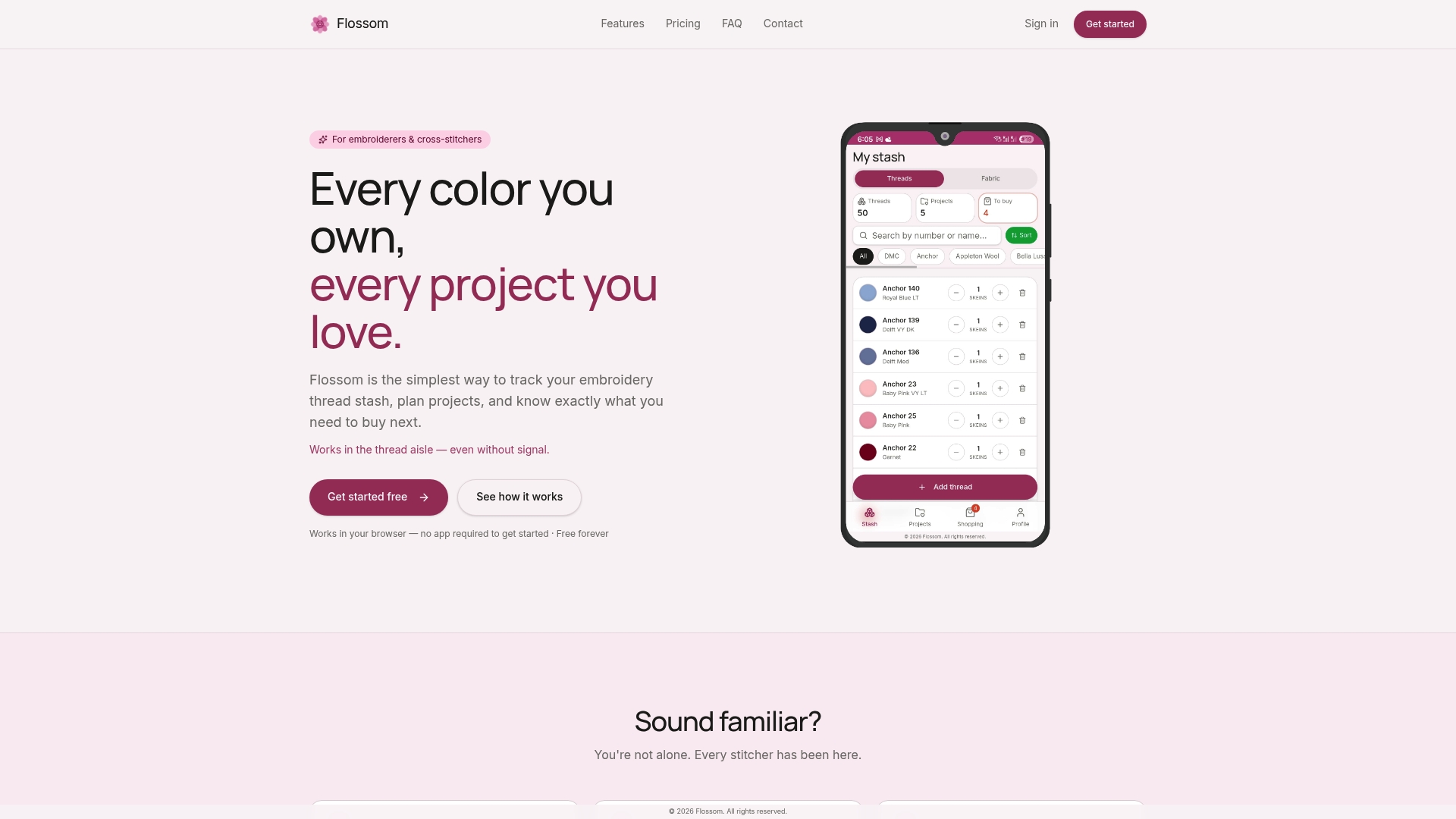
Flossom's fabric size calculator takes your stitch count and fabric count and returns the exact fabric dimensions you need, including the recommended margin. No math, no guessing, no wasted fabric. The full tools suite also includes a project time calculator and a pattern size calculator, so you can plan every dimension of your project before you pick up a needle. Flossom is free to start, works in any browser, and installs to your home screen on iOS, Android, and desktop.
FAQ
What is the best cross stitch fabric for beginners?
14-count Aida is the best starting fabric for beginners. Its block-weave grid creates clear holes that make stitch placement and counting straightforward.
What does fabric count mean in cross stitch?
Fabric count is the number of stitches that fit in one inch of fabric. A higher count produces smaller, finer stitches and a smaller finished design.
How do I calculate how much fabric I need?
Divide your design's stitch count by the fabric count to get the finished design size in inches, then add at least 2 inches on all sides for hooping and framing margin.
What needle size should I use for 14-count Aida?
A size 24 tapestry needle is the standard recommendation for 14-count Aida. The blunt tip glides between threads without splitting the fabric.
Do I need backing fabric for cross stitch?
Woven fabrics like Aida and linen rarely need a stabilizer during stitching. For framing, use an acid-free mount board as backing to prevent yellowing and preserve your work long-term.
Recommended
We make Flossom — the calm app for cross-stitchers and embroiderers who want their stash, projects, fabric and shopping list in one tidy place.