
Why Plan Thread Purchases: A Cross-Stitcher's Workflow
Why Plan Thread Purchases: A Cross-Stitcher's Workflow ! Woman organizing cross-stitch thread at home table Planning your thread purchases prevents duplicate buys, protects color consistency across large projects, and cuts the time you spend hunting through project bags for a skein you swear you already own.

Why Plan Thread Purchases: A Cross-Stitcher's Workflow
Planning your thread purchases prevents duplicate buys, protects color consistency across large projects, and cuts the time you spend hunting through project bags for a skein you swear you already own. For stitchers juggling multiple WIPs, a little upfront organization pays back every time you sit down to stitch.
The short version:
- Money saved. Duplicate skeins silently drain your budget. Unplanned shopping trips often lead to purchasing colors you already own.
- Color safety. Dye lots vary between production runs. Running out mid-sky background and buying a replacement skein risks a visible shade shift in your finished piece.
- Less frustration. Knowing exactly what you own means you start stitching faster and interrupt your creative flow less often.
Start with a 20–30 minute stash audit, or skip straight to an automated tool that does the matching for you.
Table of Contents
- Why planning your thread purchases actually pays off
- What a simple planning workflow actually looks like
- Which method should you use to plan thread purchases?
- How Flossom maps to the planning workflow
- How much time and money does planning actually take?
- Common mistakes that cause duplicate purchases
- What to do next: start planning your thread purchases today
- Key Takeaways
- The habit that changed how I stitch
- Flossom takes the matching off your plate
- Useful sources and further reading
Why planning your thread purchases actually pays off
The benefits break down into five categories, and each one hits differently depending on how many projects you have going at once.
- Stop buying duplicates. Organization prevents duplicate purchases and reduces the time spent hunting for colors. If you have 200 skeins spread across three project bags and a drawer, you are buying blind without a list.
- Protect dye-lot consistency. Dye-lot differences are subtle by eye but visible when stitched side-by-side, especially across large solid-color areas like a sky or a background fill. Buying all the skeins for a dominant color upfront is the only reliable fix.
- Save time at the start of every project. Knowing your stash means you can pull thread and start stitching instead of spending 20 minutes cross-referencing a pattern against unlabeled bobbins.
- Protect creative flow. Mid-project supply runs break concentration. Stitchers with multiple WIPs feel this acutely: switching projects is already a context shift, and discovering a missing color on top of that kills momentum.
- Buy only what you need. Inventory-driven shopping replaces impulse buying with a precise list. You spend less overall, and what you do spend goes toward colors that actually move a project forward.
There is also a quieter benefit that practitioners mention: the psychological satisfaction of an organized stash. Regular inventory check-ins can make the chore enjoyable and reduce hobby-related stress, turning what feels like admin into a rewarding part of the craft itself.
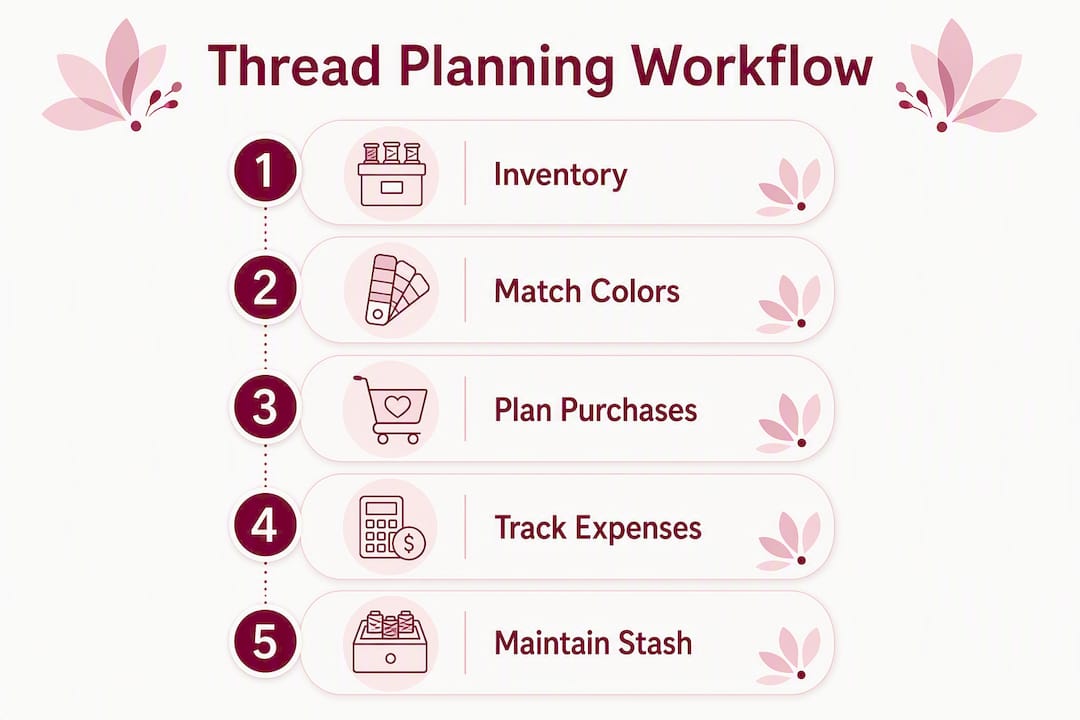
What a simple planning workflow actually looks like
The process has five steps. None of them require special tools, though tools speed everything up considerably.
- Capture brand and color code. For every skein you own, note the brand (DMC, Anchor, Cosmo, etc.) and the exact color number. A label on the bobbin or a photo of the skein wrapper works.
- Record quantity. Log how many full skeins you have and flag any partial skeins. Partial skeins matter: a half-skein of a background color may not be enough to finish a large fill.
- Photograph or note location. Which project bag, box, or drawer? This step sounds trivial until you have four active WIPs and can't find DMC 3750 anywhere.
- Log your pattern's thread requirements. Most patterns include a thread list. If yours doesn't, per-color stitch counts give the most accurate basis for skein calculations. Enter those counts into a thread calculator along with your fabric count and strand count.
- Compare stash to requirements and generate a shopping list. Whatever you're short on goes on the list. Add a 20% safety margin to your calculated needs to cover thread tails, frogging, and unusable remnants. Thread calculators commonly include a standard 20% buffer, with higher coverage for confetti-heavy patterns where cut-and-start waste is frequent.
One note on strand count: most stitchers use 2 strands on 14-count Aida, but switching to 3 strands increases consumption by about half. If you're planning a project on higher-count fabric with a different strand setup, recalculate before you shop.
Pro Tip: Keep a hybrid system: wind skeins onto labeled bobbins for physical access and visual checks, and maintain a synced digital record as your backup. Stitchers who lost app data and rebuilt from scratch consistently report that a physical fallback saved them hours of re-logging.

Which method should you use to plan thread purchases?
| Method | Best for | Key limitation |
|---|---|---|
| Labeled bobbins + compartment box | Any stash; great for visual access | No automatic comparison to pattern needs |
| Spreadsheet (Google Sheets, Excel) | Small-to-medium stash, one or two WIPs | Manual data entry; no brand conversion |
| Printable tracker | In-store shopping checks | Static; doesn't update as stash changes |
| Dedicated app (e.g., Flossom) | Growing stash, multiple WIPs, multi-brand | Requires initial setup time |
Winding skeins onto labeled bobbins and storing them in compartment boxes is the most widely recommended physical method for stashes larger than about 20–30 colors. A printable tracker fits in a purse and lets you check missing colors at a store without opening boxes at home.
When choosing a method, look for these features:
- Brand coverage across the brands you actually use
- Auto shopping list generation that compares pattern needs to owned stock
- Low-stock alerts so you catch shortages before they become mid-project emergencies
- Brand conversion for when your exact color isn't available
- Photo attachments to document partial skeins and project bags
- CSV import/export for backup and portability
- Multi-device sync so your stash data is always current
For a small stash and one or two active projects, a spreadsheet or printable tracker is genuinely sufficient. Once you're managing 100+ colors across three or more WIPs, the manual upkeep of a spreadsheet starts costing more time than it saves.
How Flossom maps to the planning workflow
Flossom is built around the five-step workflow above, automating the steps that eat the most time.
| Workflow step | Flossom feature |
|---|---|
| Capture brand and color code | Barcode scanner; manual entry across 55 brands |
| Record quantity and location | Unlimited stash with quantity fields and notes |
| Compare to pattern requirements | Auto-compare: pattern PDF/photo upload vs. stash |
| Generate shopping list | Auto shopping list of missing or low-stock colors |
| Track across WIPs | Per-project thread lists, WIP photos, low-stock alerts |
The free tier covers DMC and Anchor with unlimited stash entries and up to 3 projects. Flossom Pro unlocks all 55 brands, a camera color picker, barcode scanning, fabric stash tracking, and unlimited projects. You can explore Flossom's full toolset to see what fits your workflow before committing to Pro.
Pro Tip: Use Flossom's thread conversion tool when a pattern calls for a brand you don't stock. It translates color codes across brands so you can substitute without guessing at visual matches.
How much time and money does planning actually take?
| Task | Time estimate | Typical cost impact |
|---|---|---|
| First full stash inventory | 20–45 minutes | Reveals duplicates; often uncovers $30–$80 in redundant stock |
| Per-project planning | 10–30 minutes | Avoids $5–$20 in duplicate skeins per project |
| Ongoing updates (per purchase) | 5–15 minutes | Keeps list current; prevents future duplicates |
The initial wind-and-log task is time-consuming, but maintenance updates are quick. Most stitchers find the first inventory takes a focused afternoon; after that, logging a new skein takes under a minute.
For large projects where a single dominant color requires multiple skeins, the dye-lot risk makes upfront buying worth the extra cost. Buying three skeins of a background blue at once is cheaper than buying one now and two later from a different production run.
A simple cost-tracking habit helps you see the savings accumulate: add a column to your inventory for purchase date, vendor, and price per skein. After three months, the pattern of avoided duplicates becomes visible.
Common mistakes that cause duplicate purchases
Most duplicate buys trace back to the same handful of errors.
- Not logging new skeins immediately. A skein bought at a sale and tossed in a bag without logging is invisible to your inventory within a week.
- Ignoring remnants in project bags. A partial skein of DMC 321 in a finished project bag still counts as stock. Pull it, log it, and store it with your main stash.
- Counting by eye. Estimating "I think I have two skeins of this" is how you end up with five.
- Forgetting strand count. A project using 3 strands instead of 2 needs 50% more thread. Recalculate when your setup changes.
- Skipping dye-lot checks for large fills. Buy all skeins for dominant colors at once, from the same retailer and batch when possible.
Pro Tip: Before any shopping trip, take a quick phone photo of your stash for that color and search your inventory app or spreadsheet. Thirty seconds of checking prevents a $10 mistake.
- Pull all project bags and check for partial skeins before shopping.
- Search your inventory by color code, not by memory.
- If your exact brand isn't available, use a conversion chart or tool before substituting visually.
What to do next: start planning your thread purchases today
Here is a timeboxed plan you can start right now.
- 20–45 minutes: Do a stash audit. Pull every skein, wind onto labeled bobbins if you haven't already, and log brand, color code, and quantity.
- 15–20 minutes: Log three active WIPs and their thread requirements. Use the pattern's thread list or a stitch-count calculator if the list is missing.
- 5–10 minutes: Compare stash to requirements and write a shopping list of what's missing.
- After shopping: Log every new skein immediately before it goes into a bag.
The low-effort alternative: try Flossom's free tier with one pattern to see the auto-generated shopping list in action. It takes about 10 minutes to set up and shows you exactly what the comparison step looks like when it's automated.
Make inventory a monthly habit. A 10–15 minute check-in at the start of each month keeps your records current and catches low-stock colors before they become mid-project problems.
Key Takeaways
Planning thread purchases prevents duplicate buys, protects dye-lot consistency, and cuts per-project setup time to under 30 minutes once your stash is logged.
| Point | Details |
|---|---|
| Duplicates are a real cost | Unplanned purchases cost $5–$20 per mistake; a logged stash stops this immediately. |
| Dye-lot risk is highest for fills | Buy all skeins for dominant colors upfront to avoid visible shade variation. |
| Add a 20% safety margin | Thread calculators use a standard 20% buffer to cover tails, frogging, and unusable remnants. |
| Hybrid systems are most resilient | A physical bobbin system plus a synced digital record protects against app data loss. |
| Flossom automates the hard steps | Auto shopping lists, 55-brand conversions, and low-stock alerts handle matching for multi-WIP stitchers. |
The habit that changed how I stitch
Most stitchers treat inventory as a chore to avoid. That framing is what keeps them buying duplicates and losing momentum mid-project. The shift happens when you start treating it as part of the creative process rather than separate from it.
There is real psychological satisfaction in an organized stash. Practitioners who have written about returning to analog tracking after app failures describe something unexpected: the act of physically handling and logging thread became calming, almost meditative. The organized stash stopped feeling like a database and started feeling like a resource you actually trust.
For stitchers with multiple WIPs, that trust is the whole point. When you sit down to stitch and you know exactly what you have, where it is, and what each project still needs, the decision fatigue disappears. You just stitch. That is what a good planning habit actually buys you, and no amount of duplicate skeins can substitute for it.
Flossom takes the matching off your plate
If the workflow above sounds useful but the manual upkeep sounds like too much, Flossom handles the parts that eat time. Upload a pattern PDF, and it compares the thread list against your logged stash automatically, then generates a shopping list of exactly what's missing. No spreadsheet formulas, no manual cross-referencing.
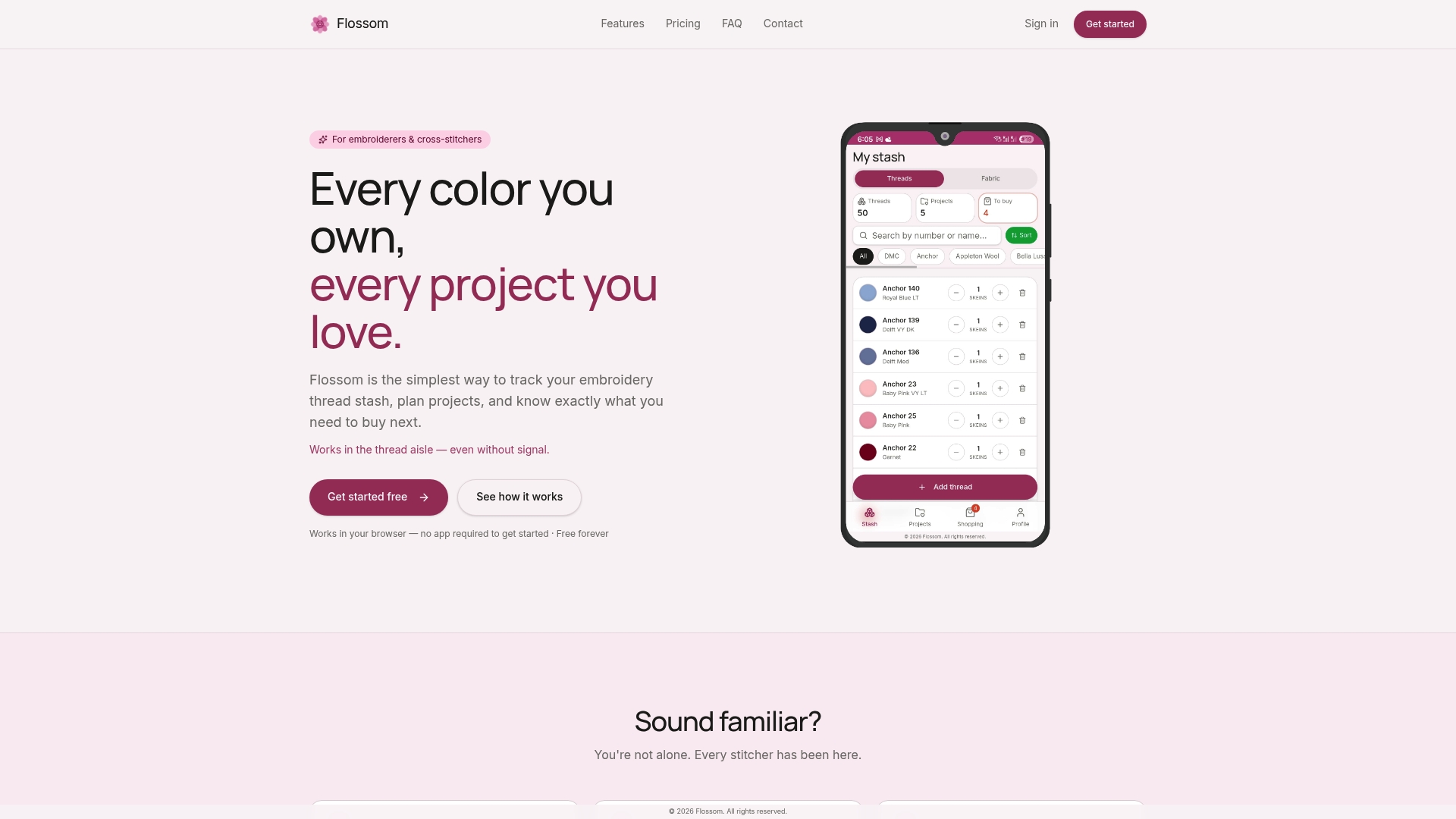
The free tier gives you unlimited stash entries, DMC and Anchor support, and up to 3 projects. That is enough to test the auto-shopping-list feature with a real pattern and see whether it fits your workflow. Flossom Pro adds all 55 brands, a barcode scanner, camera color picker, fabric stash tracking, and unlimited projects.
For stitchers who work across multiple brands or juggle more than a few WIPs, the thread conversion tool alone is worth the setup time. Try the free tier at flossom.app and run one pattern through it before your next shopping trip.
Useful sources and further reading
- Cross Stitch Thread & Floss Calculator — How Many Skeins? (Stitchmate) — supports the 20% safety margin, strand-count calculations, and dye-lot guidance throughout this article.
- Taking Control of Your Thread Stash: My Journey Back to Basics (Flourishing Fibers) — source for inventory time estimates, hybrid system recommendations, and the psychological benefit insight.
- How to Organise Cross Stitch Thread (The Stitchery Corner) — bobbin and compartment-box storage recommendations; supports the physical organization sections.
- How To Create A DMC Floss Inventory — Printable Thread Tracker (Lost In Cross Stitch) — printable tracker option for in-store checks; referenced in tools and methods.
- How Much Floss Needed for Cross Stitch: Complete Guide (Cross Stitch Boutique) — background on skein yield and per-project floss requirements.
- Flossom thread inventory and stash guides — deeper reading on cataloguing formats, organization workflows, and digital-first strategies.
Recommended
We make Flossom — the calm app for cross-stitchers and embroiderers who want their stash, projects, fabric and shopping list in one tidy place.