
50 Stitch Swatch Test: Choose Parking or Cross Country for Stitchers
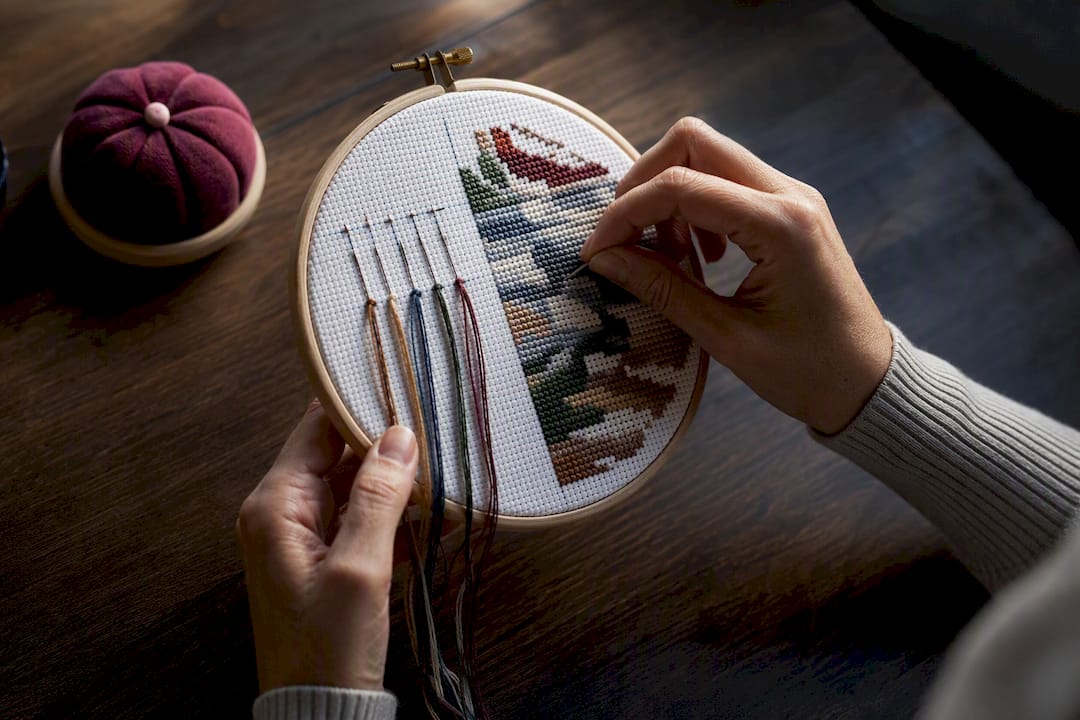
50 Stitch Swatch Test: Choose Parking or Cross Country for Stitchers ! Cross stitch swatch testing two stitching methods Parking wins for confetti-heavy, full-coverage designs where miscounting is the real enemy.
50 Stitch Swatch Test: Choose Parking or Cross Country for Stitchers
Parking wins for confetti-heavy, full-coverage designs where miscounting is the real enemy. Cross country wins for large single-color blocks where you want fewer dangling threads and longer stretches of uninterrupted stitching. Most experienced stitchers eventually land on a hybrid of both. Stitch a small swatch each way before committing to a full piece.
TL;DR:
- Parking is best suited for confetti-heavy, full-coverage designs to minimize errors, but it creates tangled floss and requires more needle management.
- Cross country excels in large single-color blocks, offering faster stitching and a tidier front but increasing the risk of miscounts and visible carry-through on the back.
- On higher-count fabrics, parking is generally safer due to difficulty spotting and correcting errors, whereas lower count fabrics favor cross country's speed.
- Hybrid workflows combining both methods, such as locking in dominant colors with cross country and parking for accents, optimize speed and accuracy during complex projects.
- Proper planning, including fabric marking and thread management, helps prevent confusion when switching methods mid-project and improves overall stitcher efficiency.
Table of Contents
- What Is Parking in Cross Stitch?
- What Is Cross Country Stitching?
- Parking vs Cross Country: A Side-by-Side Look
- How Do You Choose the Right Method for Your Project?
- Hybrid Workflows Experienced Stitchers Actually Use
- Marking Systems and Thread Management That Actually Help
- Why the Method You Enjoy Beats the Method That's "Correct"
- How Flossom Keeps Hybrid Stitching From Turning Into a Mess
- Tutorials and Community Threads Worth Reading
- Sources
- FAQ
What Is Parking in Cross Stitch?
Parking means you stitch a color, then bring that thread to the front of the fabric at the next spot it appears, leaving it there until you circle back to work it. You're not cutting and restarting constantly. You're holding your place.
Here's how it typically works in practice:
- Pick your first color and stitch every occurrence you can reach without excessive carrying.
- When you hit a gap too wide to carry across, "park" the thread by pulling it through to the front at the next spot that color belongs.
- Move to the next color and repeat, building up a field of parked threads across the fabric.
- Circle back through parked threads in the order you left them, completing each as you reach it.
The one rule that keeps this from turning into chaos: pick a consistent parking corner (top-left of the stitch, say) and stick to it every time. Stitching Daily's parking tutorial notes that this consistency is what prevents mapping errors once dozens of colors are live at once.
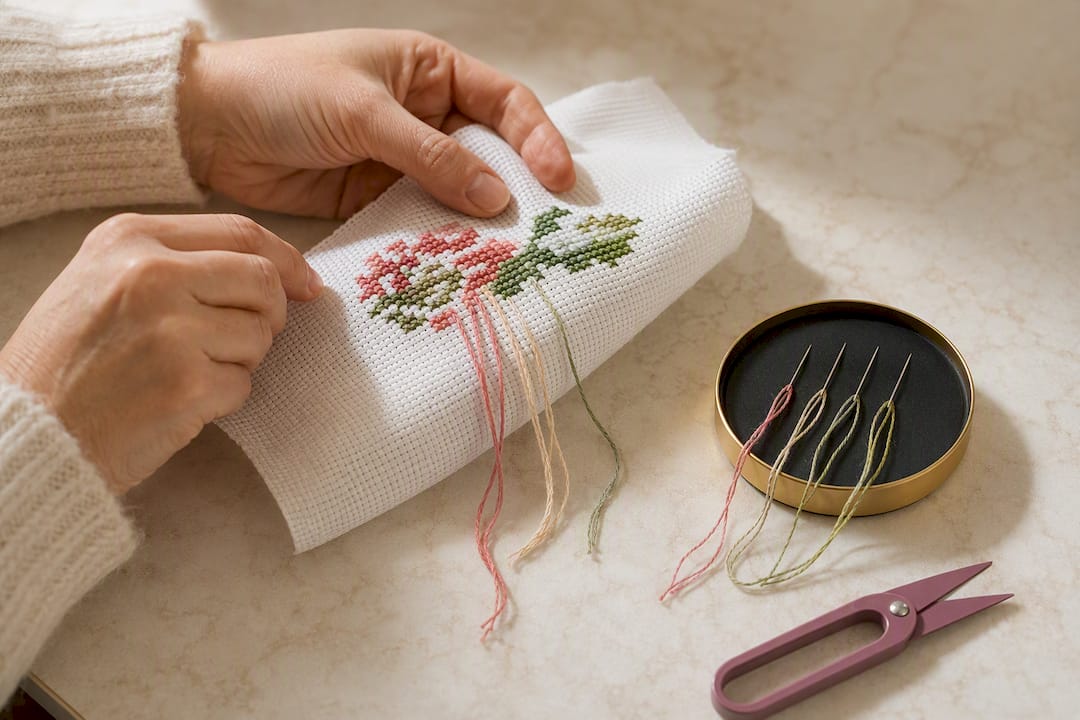
Stitchers reach for parking on confetti-heavy, full-coverage pieces where colors change every few stitches. The trade-off is a front covered in dangling floss and more time spent rethreading needles. A simple fix: use small needle organizers or magnetic boards to keep parked needles from tangling into each other while they wait.
What Is Cross Country Stitching?
Cross country flips the priority. Instead of chasing individual colors around the whole piece, you finish one color across an entire section, or even the whole project, before switching. Some stitchers call this "extreme" cross country when it spans the full design, and "limited" cross country when it's confined to one motif or block.
The appeal is speed and a cleaner working surface:
- Longer, uninterrupted thread runs mean fewer needle changes per hour of stitching.
- Almost nothing dangles at the front while you work, so the piece looks tidier as you go.
- It suits solid backgrounds, borders, and any large area dominated by one or two colors.
- It rewards confident counters who can track their position across long stretches of fabric.
The catch is counting risk. Miscount once on a long cross-country run and you can carry that error across a wide swath before you spot it. There's also a subtler problem: threads carried behind large blocks can create show-through or banding at the seams where sections meet, an issue Peacock & Fig's cross country guide flags directly. Cross country tends to shine on gridded, evenweave fabric where the stitcher already has a strong sense of scale and placement.
Parking vs Cross Country: A Side-by-Side Look
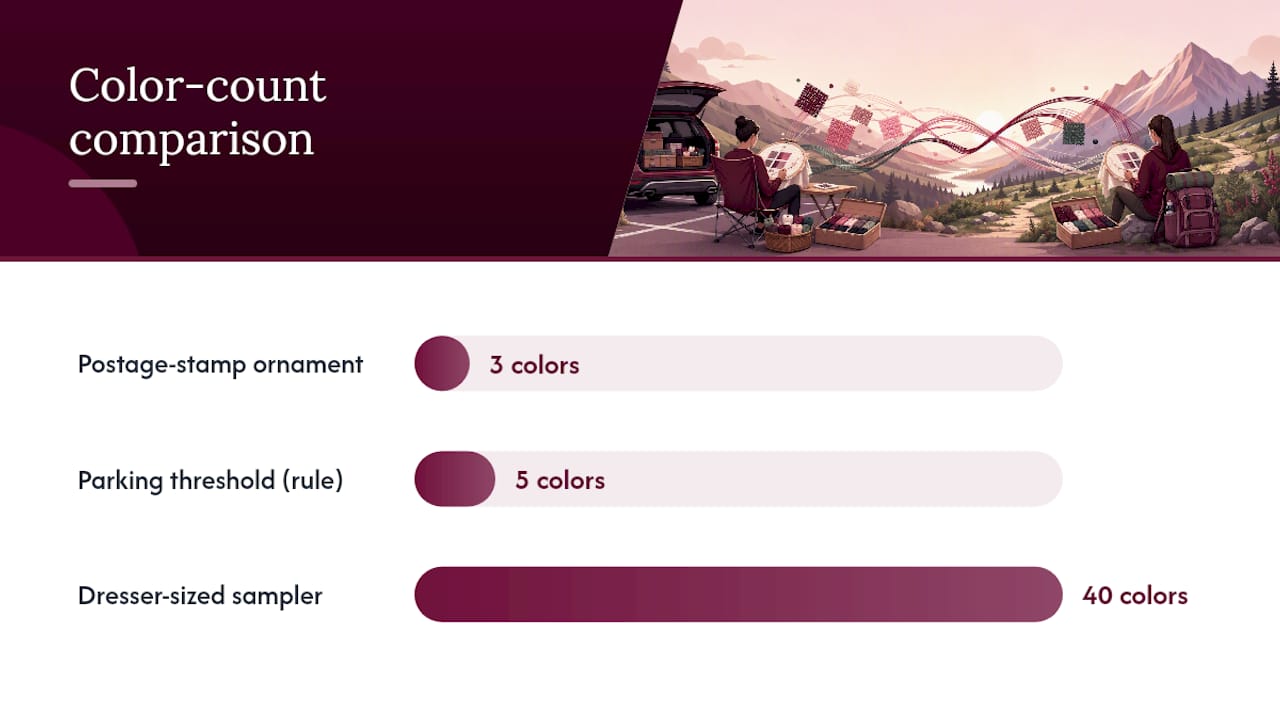
Confetti density is the single biggest variable in this decision. A rough rule of thumb from community discussion: once a 10x10 stitch block holds more than four or five distinct colors, parking starts to outpace cross country on accuracy, even though it feels slower stitch for stitch.
| Dimension | Parking | Cross country |
|---|---|---|
| Best for | Confetti-heavy, full-coverage designs | Large single-color blocks, borders, backgrounds |
| Speed/efficiency | Slower per stitch due to frequent pattern checks | Faster over long solid runs |
| Counting difficulty/error risk | Lower risk per stitch, contained mistakes | Higher risk over long stretches; errors travel further |
| Back appearance | Neater back, more parked ends up front | Cleaner front, but carried threads can show through the back |
| Needle/thread management | Multiple needles or a parking board needed | Fewer needle changes, simpler thread rotation |
| When to prefer | Sampler-style pieces, portraits, dense florals | Solid backgrounds, geometric borders, monochrome sections |
Fabric count changes the math a little. On higher-count fabric (28 count and up), even small counting errors are harder to spot and fix, which nudges the calculation toward parking for anything but the simplest blocks. On 14 count Aida, cross country's speed advantage tends to matter more because the stitches themselves are more forgiving to eyeball and correct.
Scale matters too. A postage-stamp-sized ornament with three colors barely needs either method formally defined. A dresser-sized sampler with 40 DMC colors is where the choice between cross country parking solutions actually changes how the next several weeks of stitching feel.
How Do You Choose the Right Method for Your Project?
Run through a short checklist before threading your first needle:
- How much dangling floss can you tolerate on the front while you work? If it drives you a little crazy, lean cross country.
- How confident are you counting across long stretches without a grid or highlighted PDF? Shaky counters should lean parking.
- Is the design mostly confetti, mostly solid blocks, or a genuine mix of both?
- What's the fabric count? Higher counts raise the cost of a counting mistake.
- Are you stitching in hand or on a frame? Frames make parking's needle shuffle easier to manage since the fabric stays put.
Then test it instead of guessing. Stitch one 50-stitch swatch using parking and a comparable 50-stitch swatch using cross country, on a scrap of the same fabric. Time both, and count how many times you had to rip out stitches on each. That single comparison, done on your own hands and your own eyes, tells you more than any general rule.
Pro Tip: Run the swatch test on the actual pattern section that worries you most, not a random practice square. A confetti-dense border behaves nothing like a solid background, and you want the test to match the problem you're actually solving.
Watch for red flags mid-project that signal a switch is overdue: repeated frogging in the same area, needles piling up faster than you can manage them, or a back that's turning into a mess of long carried threads. None of these mean you chose wrongly. They mean the project just changed shape on you.
Hybrid Workflows Experienced Stitchers Actually Use
Very few long-time stitchers commit to one method for an entire piece. The common pattern is a hybrid: cross country for the boring stretches, parking for the chaos.
A workflow that shows up again and again in tutorials and forums:
- Break the design into 10x10 stitch blocks and treat each block as its own decision.
- Stitch the dominant color in each block first, cross-country style, to lock in the frame.
- Park the minor and accent colors within that same block as you encounter them.
- Treat the block's edge stitches as consistent "tie-in" points, worked in one direction, to avoid the banding and tension shifts that Peacock & Fig warns about at section boundaries.
This block-limited approach gives you cross country's speed on the bulk of the fabric and parking's accuracy exactly where the confetti gets dense. The bookkeeping is the hard part. Once you're juggling six parked colors in one block and three finished ones in the next, it helps to have a running note of what's active, what's parked, and what's done, whether that's a marked-up pattern PDF or a digital project log.
Marking Systems and Thread Management That Actually Help
Small friction points, multiplied across thousands of stitches, are what make a technique feel harder than it should. Fix the friction and either method gets easier.
Marking systems worth setting up before you start a dense section:
- Grid your fabric in 10x10 blocks with a washable marker or basting thread to match your pattern's grid.
- Highlight completed rows on a printed or PDF pattern in one color and parked-but-unworked symbols in another.
- Use a dual-marker system, one color for "started," one for "finished," so a glance tells you status without recounting.
On thread length, Stitching Daily recommends limiting how far you carry a thread, generally under an inch and a half, before cutting and restarting instead. Longer carries waste floss and risk show-through on lighter fabrics. Pre-cutting several lengths of your most-used colors before you sit down saves real time versus stopping to cut floss mid-section. Leaving needles threaded on parked colors speeds up your return to them, but it also means buying or organizing enough needles to match your color count, so a small needle organizer or magnetic parking board earns its keep fast.
Pro Tip: Before starting a confetti-dense section, do a five-minute readiness pass: count your colors, confirm you have enough needles, and check your thread lengths against how far each color has to travel across the design.
For general thread-tail management technique beyond cross stitch, these yarn tail techniques cover similar carry-and-tension principles that apply across needlework.
Why the Method You Enjoy Beats the Method That's "Correct"
There's no single right answer here, and pretending otherwise sets stitchers up to fight their own project. Plenty of skilled stitchers use a different method for every single piece, sometimes switching two or three times inside the same design once they hit a new section. That's not indecision. That's the craft working the way it's supposed to.
Prioritize whichever method keeps your hands moving and your error count low. If a technique stops feeling good halfway through a piece, switch it. Nobody is grading your consistency.
— Simone
How Flossom Keeps Hybrid Stitching From Turning Into a Mess
The hardest part of hybrid stitching isn't the counting. It's remembering which of eleven parked colors you already finished in block four and which one is still waiting three inches down. Some digital tools help you log your active project, parked threads, and stash in one place, so switching between parking and cross country mid-piece doesn't mean losing track of your own progress.
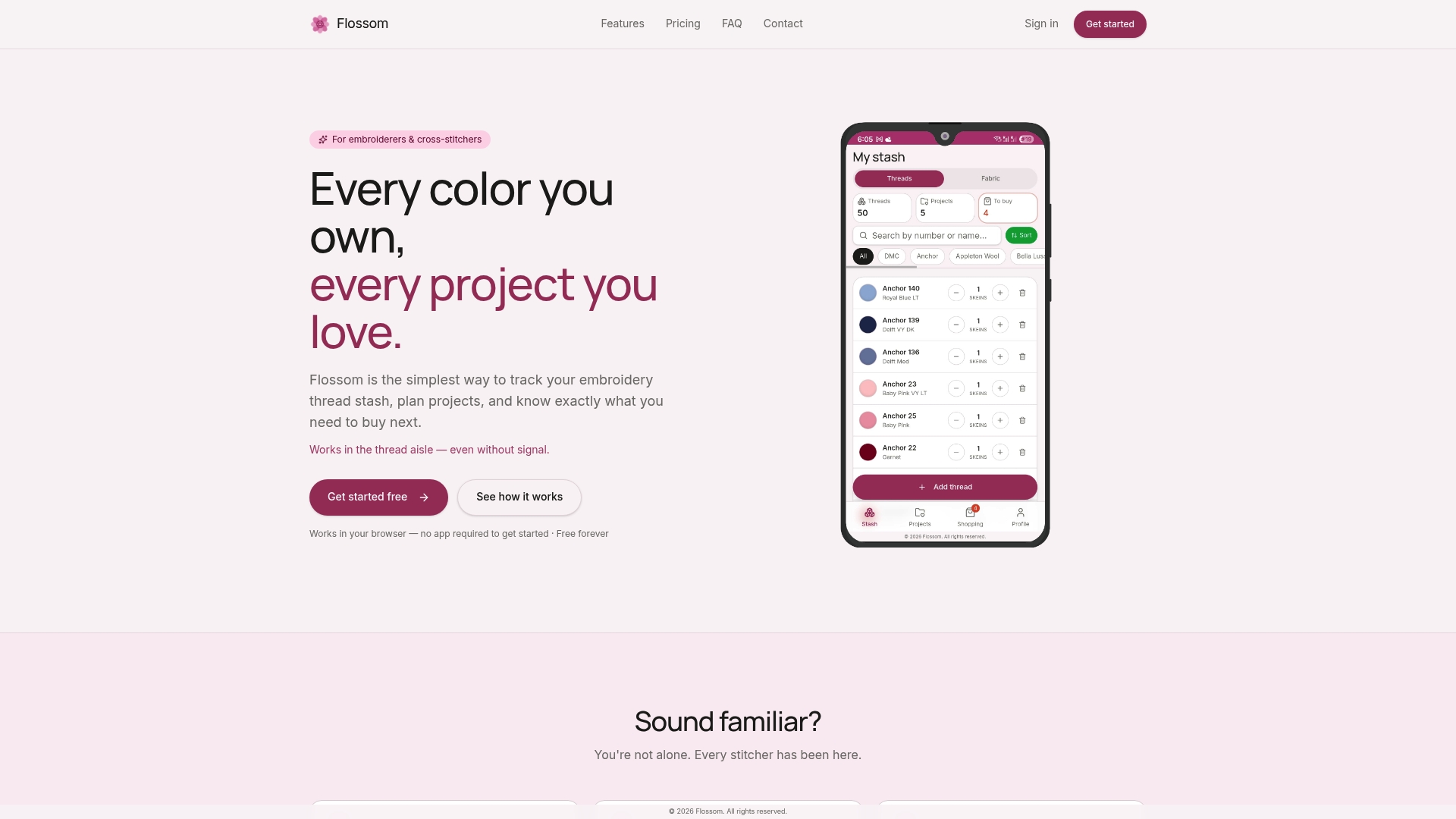
If you're planning the two-swatch test from earlier, Flossom's Project Time Calculator helps you estimate how long a section will actually take under each method before you commit hours to it. The broader tools page covers stash tracking and shopping list generation for whichever colors your hybrid plan calls for. None of this decides parking versus cross country for you. It just means the bookkeeping doesn't get in the way of the decision. Start a free project on a stitch planning app and try both methods on your next piece without losing track of either.
Tutorials and Community Threads Worth Reading
For a full walkthrough with photos of the parking method in motion, Stitching Daily's step-by-step guide breaks down each stage. Peacock & Fig's comparison of the two methods draws on designer Dana Batho's practical experience with hybrids. For real stitcher opinions and speed reports, the r/CrossStitch discussion on parking vs cross country is worth scanning for honest, mixed feedback from people mid-project.
Sources
- Cross Stitch Parking Method: Learn this Cross Stitch Technique - Stitching Daily
- Cross stitch - cross country stitching - Peacock & Fig
FAQ
What's the difference between cross country and parking in cross stitch?
Parking stitches a color and holds the thread at its next occurrence to reduce counting errors, while cross country finishes one color across a whole section or project before moving to the next, favoring speed over error containment.
Which is harder, cross stitch or embroidery?
They test different skills. Cross stitch demands precise counting and grid awareness, while embroidery often relies more on freehand stitch control, so "harder" depends on which skill you already have.
What's the difference between Aida and evenweave fabric?
Aida has a stiffer, block-woven structure that makes stitch placement easy to count, while evenweave is a single-thread weave that gives a finer finish but takes more care to count accurately, which matters more once you're using cross country over long stretches.
Is cross stitch outdated?
No. Cross stitch has seen a steady resurgence through modern pattern designers and online communities, and tools like Flossom that manage stash and projects digitally show the craft is adapting rather than fading.
Can I switch between parking and cross country in the same project?
Yes, and many experienced stitchers do exactly that, often using cross country for large solid blocks and parking for confetti-dense sections within the same piece.
Recommended
We make Flossom — the calm app for cross-stitchers and embroiderers who want their stash, projects, fabric and shopping list in one tidy place.