
Why Park Threads While Stitching: A Complete Guide
Discover why park threads while stitching can save you time and reduce waste. Learn how this technique enhances your cross stitch projects.

Why Park Threads While Stitching: A Complete Guide
Thread parking is defined as the practice of leaving an active thread strand on the fabric surface at the exact spot where it will next be needed, rather than tying it off and cutting it. Stitchers who park threads while stitching avoid the constant cycle of starting and stopping each color, which saves time, reduces thread waste, and keeps the back of the fabric clean. This technique is especially powerful in confetti-heavy cross stitch patterns, where dozens of colors appear in scattered, non-contiguous blocks. Whether you stitch a single color at a time or juggle ten needles at once, understanding thread parking will change how you approach complex projects.
Why park threads while stitching?
Thread parking reduces the frequency of starting and stopping each color, which is the single biggest drain on time and thread in complex cross stitch work. Every time you tie off a thread and start a new one, you lose a tail to the knot and add bulk to the back of your fabric. Parking eliminates most of those tie-offs entirely.
The benefits of parking threads stack up quickly across a project:
- Less thread waste. Parking saves expensive floss by limiting the number of tied-off ends. This matters most with limited-edition or hand-dyed threads you cannot easily replace.
- Neater fabric back. Fewer knots and tails mean a flatter, less bulky reverse side. That is a real advantage if your finished piece will be framed or displayed where the back is visible.
- Consistent stitch tension. Keeping a thread live and ready prevents the slight tension shifts that happen when you re-thread and restart. Your stitches stay uniform across a block.
- Simpler color management. In a confetti pattern with 40 colors, parking lets you see exactly which thread belongs where without re-reading the chart every few stitches.
- Easier frogging. Parked threads act as visual markers tied to exact chart locations. When you need to remove stitches, those markers tell you where each color was headed, so you disturb fewer surrounding stitches and make fewer recount errors.
Pro Tip: If you stitch with DMC or Anchor threads and find yourself cutting short lengths constantly, parking is the fastest way to stretch your floss further without buying more.
The mental load reduction is just as significant as the physical benefits. Parking offloads color counting to the parked thread itself, freeing your brain to focus on placing stitches correctly rather than tracking which color goes where.
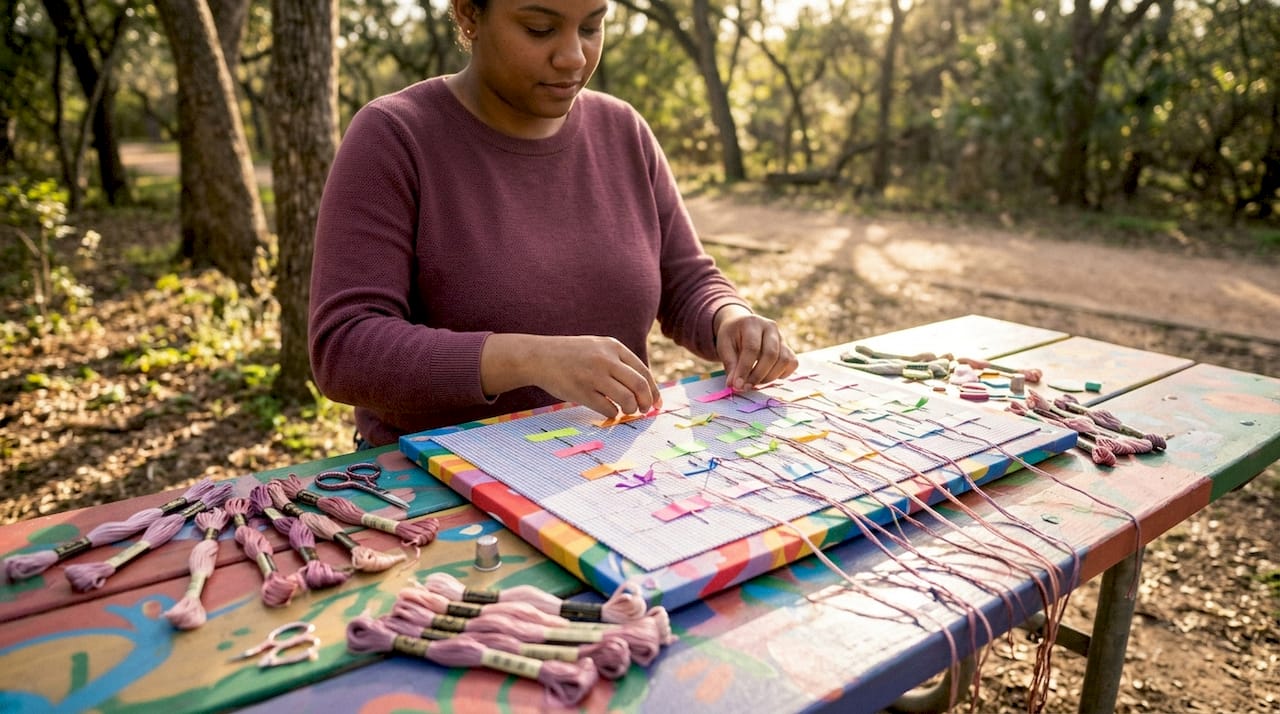
How to park threads: step-by-step techniques
The core mechanics of parking are straightforward, but consistency is what makes the method work. Follow these steps to build a reliable parking routine from your first project.
- Choose a working block. Divide your pattern into 10x10 stitch sections. Working in defined 10x10 blocks vertically or horizontally gives you a manageable unit and prevents threads from stretching too far across the fabric.
- Pick a consistent parking corner. Always park your thread in the same corner of each block, such as the bottom-left. Consistency in parking location is critical. Switching corners mid-project creates confusion when you return to a parked thread after several sessions.
- Bring the needle up at the next stitch point. When you finish the last stitch of a color in your current block, bring the needle up through the fabric at the exact spot where that color will be needed next. Leave the thread hanging on the surface.
- Move to the next color. Pick up a new needle threaded with the next color and stitch that color's portion of the block. Each color gets its own needle, which stays threaded and parked until needed.
- Use a thread organizer or magnetic board. Lay parked needles across a magnetic board or thread organizer beside your hoop. This keeps them ordered and prevents the threads from crossing and tangling while you work.
- Return to parked threads in order. Work through your block systematically. When you reach the spot where a thread is parked, pick up that needle and continue stitching without re-threading or re-counting.
Pro Tip: Label your needles with small sticky tabs numbered by color code. When you have 15 needles parked at once, a quick glance at the label saves you from squinting at thread colors under artificial light.
One pitfall trips up nearly every stitcher who tries parking for the first time. Stitching over a parked thread traps it under new stitches, creating bulk and making it impossible to remove later without cutting. Always check that your parked threads lie clear of the area you are actively stitching.
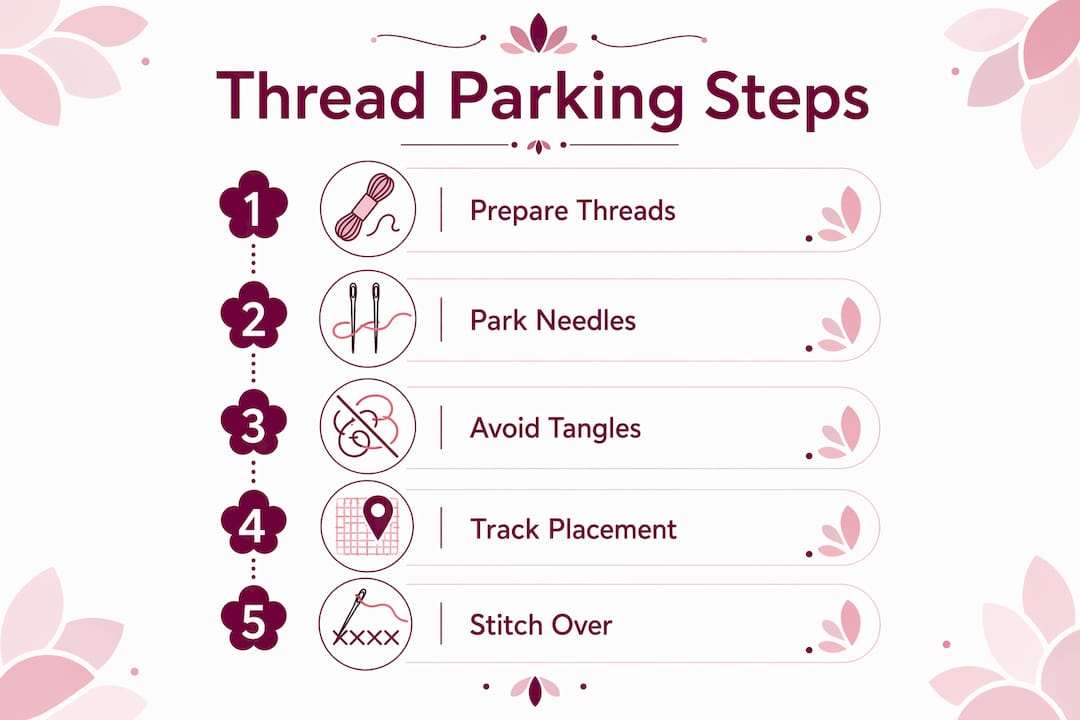
When should you park threads vs. use other methods?
Thread parking is not the right tool for every project. Knowing when to use it and when to skip it saves you from adding unnecessary complexity to simple work.
Parking delivers the most value in these situations:
- Confetti-heavy patterns. Any design where colors appear in single stitches scattered across a wide area is a prime candidate. Parking prevents you from tying off after every single stitch.
- Large, complex portraits or gradients. Designs with subtle color shifts across hundreds of stitches benefit from the tension consistency that parking provides.
- Projects with expensive or irreplaceable thread. When floss is costly, parking reduces thread waste and preserves every inch of your investment.
Parking is less useful in these situations:
- Simple motifs with one or two colors. A small floral sampler with three colors does not need the overhead of multiple parked needles. Traditional cross-country stitching, where you complete all stitches of one color before moving to the next, is faster and simpler here.
- Beginner projects. If you are still learning basic stitch formation, adding parking too early can feel chaotic. Beginners often find managing parked threads overwhelming at first. Build your stitch confidence before adding this layer.
- Projects you stitch in short sessions. If you pick up your hoop for ten minutes at a time, managing a board of fifteen parked needles may slow you down more than it helps.
Parking is a tool, not a requirement. Skilled stitchers adapt their method to each project. Some never park at all. Others park only for the most complex sections of a design and use cross-country stitching for solid background areas.
Common challenges with thread parking and how to solve them
Thread tangling is the most common complaint from stitchers who try parking for the first time. Several threads hanging from the same hoop will twist around each other if left unmanaged. A magnetic needle minder board or a strip of foam with numbered slots keeps each needle separate and easy to grab.
Tracking which thread belongs where is the second major challenge. When you have 20 parked threads, picking up the wrong needle wastes time and can introduce color errors. Developing a reliable parking system takes several projects. Patience and experimentation are part of the process, not signs that you are doing it wrong.
Stitching over parked threads is the one mistake that causes real damage to your work. Before you lay down any new stitches, scan the fabric surface and move any parked threads out of the path of your needle. Make this a habit after every color change.
Pro Tip: After each stitching session, take a photo of your hoop with all parked threads visible. If you return to the project days later, the photo shows you exactly where each thread was headed without re-reading the chart.
Mental load is a real factor. Parking reduces the cognitive work of color counting, but managing many needles at once introduces its own demands. Parking significantly reduces mental load over time as the system becomes habit. Start with just three or four parked threads on your first attempt, then scale up as the routine feels natural.
Technology helps. Flossom assists in tracking thread stash, color symbols, and project progress across multiple works in progress. Pairing a digital organization tool with a physical parking system reduces errors and keeps complex projects from becoming unmanageable.
Key takeaways
Thread parking is the most effective method for managing multiple colors in complex cross stitch patterns because it reduces waste, maintains tension, and cuts the mental load of color tracking.
| Point | Details |
|---|---|
| Core definition | Parking means leaving a live thread at its next stitch location instead of tying it off. |
| Best use case | Use parking for confetti-heavy or gradient patterns with many scattered colors. |
| Consistency is critical | Always park in the same corner of each block to avoid confusion across sessions. |
| Avoid stitching over threads | Trapped parked threads create bulk and cannot be removed without cutting. |
| Scale up gradually | Start with three to four parked needles and add more as the routine becomes natural. |
What parking taught me about my own stitching
Thread parking changed my stitching more than any other single technique. Before I started parking, I dreaded confetti sections. I would put down a project for weeks rather than face a page of scattered single stitches. Parking made those sections feel manageable because I stopped thinking about the whole page and started thinking about one 10x10 block at a time.
The thing most guides do not tell you is that your first attempt at parking will probably feel worse, not better. You will tangle threads. You will stitch over one by accident. You will pick up the wrong needle. That is normal. Developing a personal parking flow is a process that takes several projects, not several sessions.
My honest advice for beginners is to try parking on a small, low-stakes project first. Pick something with five to eight colors and a moderate amount of confetti. Use that project as your practice run. By the time you finish it, the system will feel intuitive rather than chaotic.
The deeper lesson is that parking is not about being a more advanced stitcher. Parking is simply one of many valid thread management tools. Some of the most experienced stitchers I know never park. What matters is finding the method that keeps you stitching with enjoyment, not the one that looks most impressive.
— Simone
How Flossom supports your thread management
Managing parked threads gets easier when your digital organization matches your physical setup.
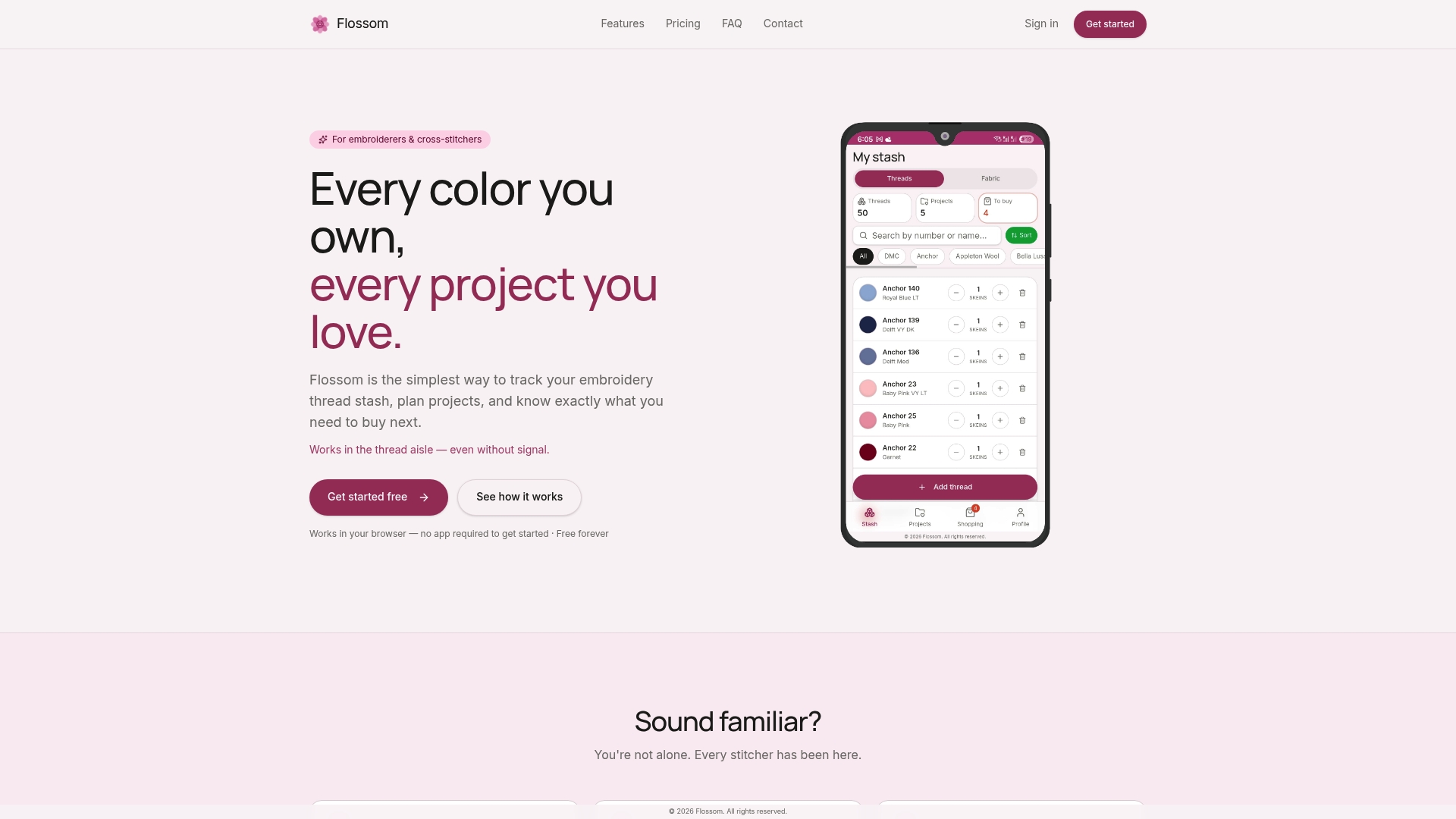
Flossom is a cross stitch and embroidery companion built for stitchers who juggle multiple works in progress. It catalogs your entire thread stash, auto-generates shopping lists by comparing pattern needs against what you already own, and converts colors across 71 thread brands. You can upload pattern PDFs, track progress with photos, and set low-stock alerts so you never run short of a color mid-project. The free tier covers DMC and Anchor with unlimited stash entries and three projects. Pro unlocks all 71 brands, a camera color picker, a barcode scanner, and unlimited projects. Everything syncs across devices and stays ad-free. Try Flossom's tools to see how digital organization complements your parking routine.
FAQ
What does it mean to park threads in cross stitch?
Parking means leaving an active thread on the fabric surface at the exact spot where it will next be stitched, rather than tying it off. This keeps the thread ready for its next use without wasting floss on a new start.
Is thread parking only for advanced stitchers?
Thread parking is a technique any stitcher can learn, not a mark of advanced skill. Beginners benefit from starting with a small number of parked threads and scaling up as the method becomes comfortable.
How do I stop parked threads from tangling?
Use a magnetic needle board or a foam organizer with numbered slots to keep each parked needle separate. Consistent placement prevents threads from crossing and tangling while you work other colors.
When is parking threads not worth the effort?
Parking adds little value to simple projects with one or two colors or to designs stitched in very short sessions. Cross-country stitching, where you complete all stitches of one color before moving to the next, is faster for straightforward motifs.
Can parking threads help me fix mistakes more easily?
Parked threads act as visual markers at exact chart locations, which makes frogging (removing stitches) faster and more accurate. They reduce recount errors and minimize disturbance to surrounding stitches during corrections.
Recommended
We make Flossom — the calm app for cross-stitchers and embroiderers who want their stash, projects, fabric and shopping list in one tidy place.