Size Cross Stitch Projects: Measure Fabric Count and Add 3 in Margins
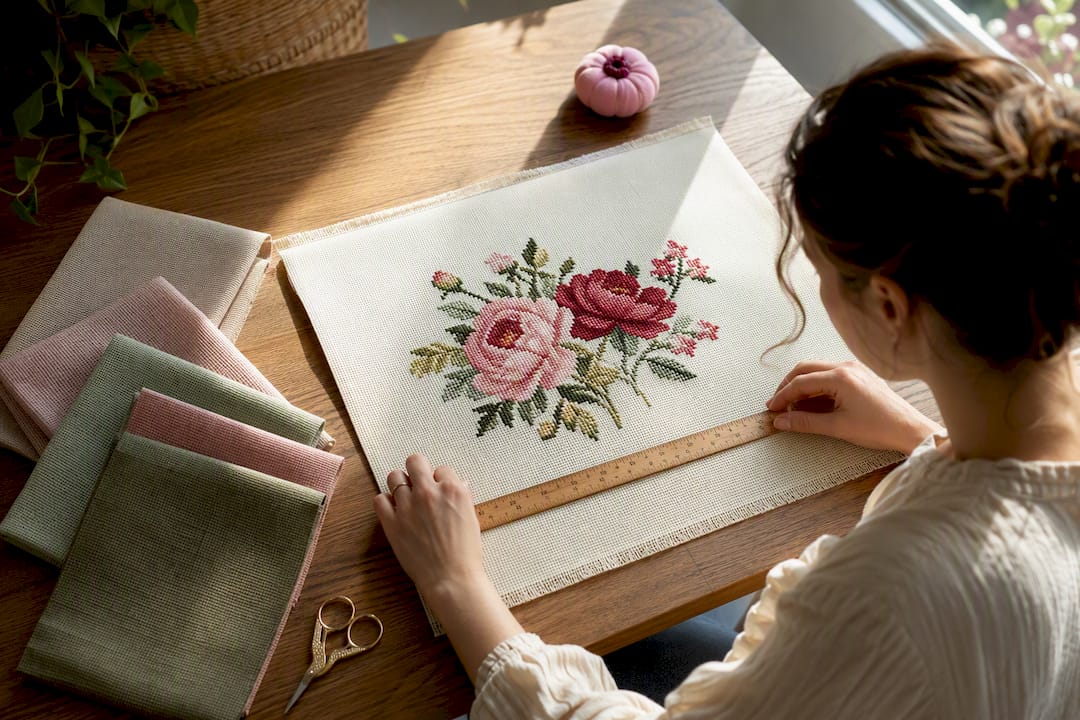
Size Cross Stitch Projects: Measure Fabric Count and Add 3 in Margins ! Measuring cross stitch fabric with ruler Fabric count is the number of stitches or threads packed into one linear inch of cloth.
Size Cross Stitch Projects: Measure Fabric Count and Add 3 in Margins
Fabric count is the number of stitches or threads packed into one linear inch of cloth. Higher count means smaller stitches, finer detail, and a smaller finished piece; lower count means larger stitches, faster progress, and a bigger finished piece. Most beginners start on 14-count Aida, while evenweave and linen are usually stitched over two threads instead of one.
TL;DR:
- Fabric count affects finished size; doubling the count results in a project about one inch smaller per side for a 100 by 100 stitch pattern at 14 versus 28 count.
- On Aida, count refers to holes per inch, while on linen and evenweave, count refers to threads per inch, with the two-thread-over stitching matching different counts.
- Beginners should start with 14-count Aida for its balance of visibility, pattern compatibility, and ease of counting, unless working on large, simple projects or fine details.
- Accurate measurement of fabric's stitch or thread count is essential for correct sizing, especially when working with unlabeled or unfamiliar fabric.
- Tools like fabric size calculators can instantly convert between fabric counts and help plan fabric purchase, preventing waste and sizing surprises.
Table of Contents
- What Is Fabric Count and How Do You Measure It?
- How Does Fabric Count Change Your Finished Size?
- What Are the Common Fabric Counts and What Are They For?
- Which Fabric Count Should You Start With?
- How Much Fabric Should You Buy for a Project?
- Can You Substitute One Fabric for Another Without Changing the Size?
- What Tools Make Stitching at Any Count Easier?
- Simone's One-Minute Checklist for Choosing Fabric Count
- Plan Your Fabric and Stash Without the Spreadsheet Chaos
- Where to Verify These Numbers Yourself
- Sources
What Is Fabric Count and How Do You Measure It?
Fabric count works differently depending on the ground you're stitching. On Aida, count refers to the number of holes, or squares, per inch. On evenweave and linen, count refers to threads per inch, and stitchers typically work over two threads at a time rather than one. That distinction trips up a lot of people who assume "28-count" and "14-count" mean the same density. 28-count evenweave stitched over two threads produces the same stitch scale as 14-count Aida, even though the number on the label looks twice as fine.
If you've got a scrap of fabric with no label, the ruler test settles it fast:
- Lay the fabric flat and place a ruler along one edge.
- Count the holes (Aida) or individual threads (evenweave/linen) across exactly one inch.
- For evenweave or linen, divide that thread count by two if you plan to stitch over two threads, since that's the number that actually determines your finished scale.
- Repeat the count in a second spot to confirm consistency, since some fabrics vary slightly across the bolt.
Packaging labels are usually accurate, but they're not gospel. A bolt end, a remnant bag, or a hand-me-down stash piece can get separated from its label entirely. When in doubt, measure it yourself. Stitchers who work with unfamiliar fabric regularly measure the actual count with a ruler before running the numbers through a calculator rather than trusting a tag that may have gotten swapped or lost.
How Does Fabric Count Change Your Finished Size?
The math is refreshingly simple: finished inches = stitch count ÷ fabric count. Stitch count comes from your pattern (the width and height in stitches), and fabric count is whatever you measured or read off the label. Divide one by the other and you know exactly how big your project will be before you thread a needle.
Here's what that looks like in practice for a 100 by 100 stitch design:
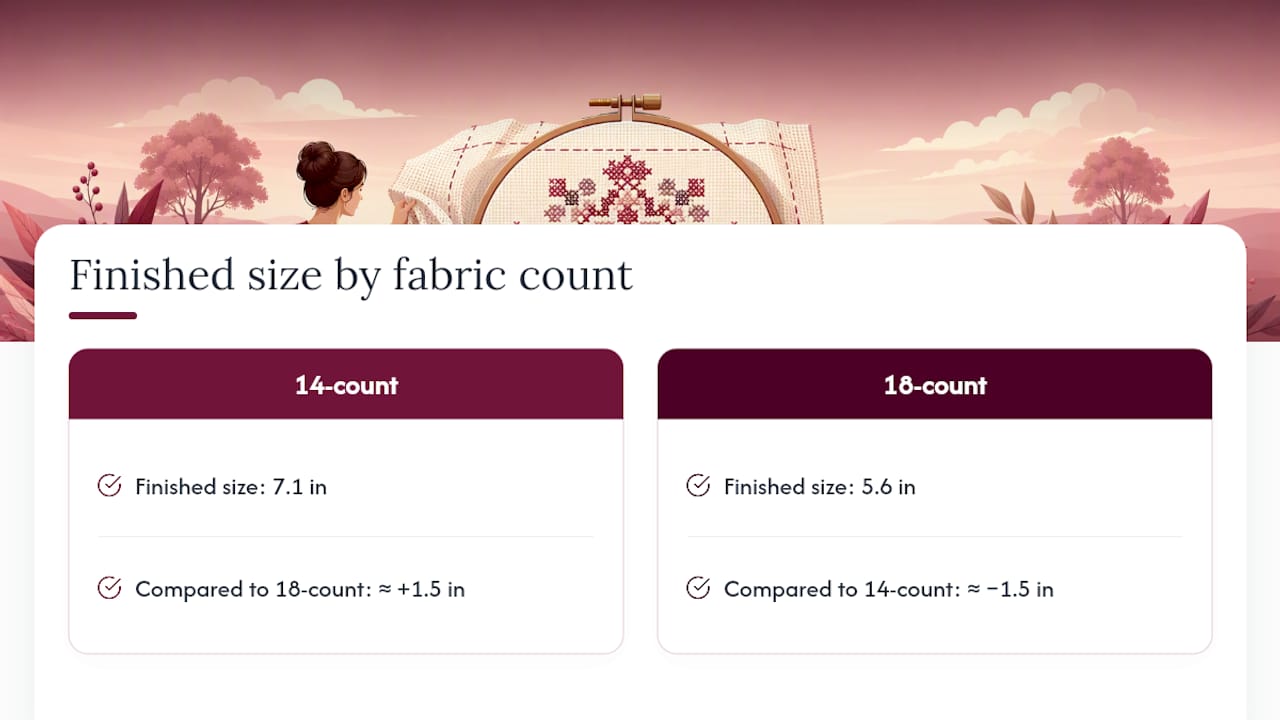
A 100 by 100 stitch pattern measures about 7.1 inches on 14-count Aida and about 5.6 inches on 18-count — a difference of about an inch and a half on each side, just from switching fabric. That's the whole story of fabric count in one comparison: same pattern, same stitches, two very different finished pieces.
Evenweave and linen complicate the math slightly because of the over-two convention. A 28-count linen stitched over two threads behaves mathematically like 14-count Aida: divide the thread count by two before you plug it into the formula. Skip that step and you'll think your linen project is going to come out twice as large as it actually will.
Doing this math by hand for every project gets old fast, especially when you're comparing three or four fabric options for the same pattern. Flossom's fabric size calculator runs the conversion instantly, and general-purpose tools like the Cross Stitch Calculator work well too if you just need a quick gut check.
What Are the Common Fabric Counts and What Are They For?
Not every count is built for the same job. Here's how the standard options break down:
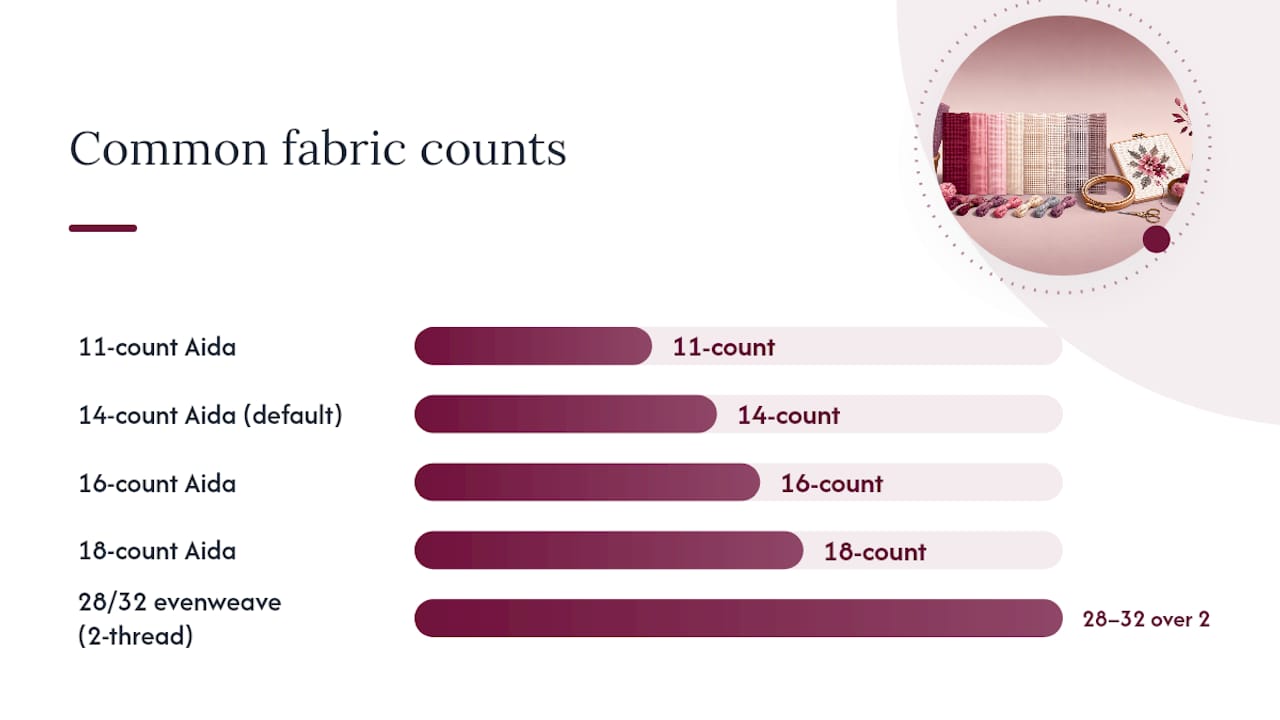
- 11-count Aida: Large, chunky stitches. Good for young stitchers, low-vision projects, or anyone who wants visible progress in an evening rather than a week.
- 14-count Aida: The workhorse. Most kits and beginner patterns are charted specifically for it, and it's the count most commonly recommended for anyone learning the craft.
- 16-count Aida: A step up in detail with only a slight increase in eye strain. Popular for stitchers who've outgrown 14-count but aren't ready for evenweave.
- 18-count Aida: Fine detail territory. Better suited to small motifs, lettering, or portrait-style patterns where every stitch counts, literally.
- 28/32-count evenweave or linen (over two): Smoother finish, finer texture, often chosen for framed pieces meant to look closer to fine needlework than a craft project.
- Specialty grounds like plastic canvas or Hardanger: built for specific outcomes such as three-dimensional ornaments or drawn-thread work, and worth reaching for only once you know why a standard Aida or evenweave won't do the job.
Lower counts move faster and strain your eyes less, which matters more than people admit, especially under indoor lighting late in the evening. Higher counts reward patience and good light, but they punish tired eyes and dim rooms.
Which Fabric Count Should You Start With?
Start with 14-count Aida. It's not just tradition. 14-count balances visibility, ease of counting, and pattern compatibility better than any other option, and because most beginner kits are charted for it directly, you avoid doing size conversions on your very first project.
There are two solid reasons to deviate from that default:
- Choose 11-count if you're stitching something large and simple, working with a stitcher who has low vision, or teaching a child. The bigger holes make counting rows almost foolproof.
- Choose 18-count if your pattern includes fine lettering, small faces, or dense shading that would look chunky and pixelated on anything coarser.
- Progress gradually rather than jumping straight from 14-count to linen. Most stitchers move from 14-count Aida to 16-count Aida, then to 28 or 32-count evenweave stitched over two threads, which feels like a smaller leap than it looks on paper since the finished stitch size barely changes.
Pro Tip: A daylight-balanced lamp and a lighted magnifier will do more for your accuracy on 16-count and finer than switching brands of floss ever will. Eye strain, not skill, is what actually slows most stitchers down on detail work.
How Much Fabric Should You Buy for a Project?
Buying fabric by guesswork is how stitchers end up either wasting expensive linen or, worse, discovering three-quarters of the way through a project that they've run out of margin. The calculation avoids both problems.
- Find your design size using the formula from earlier: stitch count ÷ fabric count.
- Add margin on every side. Most stitchers and fabric guides recommend at least 3 inches of margin on each side for handling, hooping, and framing.
- Add extra if you're finishing in a specific way. Stretching over a frame, mounting in a hoop for display, or finishing into an ornament each eat into your margin differently, so round up rather than down.
- Double the total for width and height separately, since margin applies to both sides of the design, not just one.
Before you cut anything, run through a short pre-cut checklist:
- Pre-wash fabric that might shrink or bleed, especially linen.
- Check the fabric grain and square it up before marking your cut lines.
- Press out fold lines so your stitch count doesn't drift while you're marking the center.
- Mark the horizontal and vertical center before you start stitching, not after.
For anyone who wants to skip the mental math entirely, Flossom's fabric size calculator takes your stitch count, fabric count, and margin preference and spits out a cut size in seconds. It's the same math from this section, just automated.
Can You Substitute One Fabric for Another Without Changing the Size?
Yes, as long as you respect the conversion rule: evenweave and linen counts get divided by two when stitched over two threads. That's what keeps a 28-count linen piece the same finished size as a 14-count Aida piece using the identical pattern.
What changes is the look, not just the math:
- Aida gives you a visible grid and a slightly stiff hand, which is exactly why its structure makes counting and holding a pattern straightforward for newer stitchers.
- Evenweave smooths that grid into a more even, refined surface, and it's usually stitched over two threads for a finish suited to detailed work without Aida's blocky texture.
- Linen carries a naturally irregular weave with visible slubs, which gives finished pieces an heirloom look but also means fractional stitches (quarter and three-quarter stitches) behave less predictably than they do on a perfectly uniform Aida grid.
Thread thickness matters here too. A pattern designed with heavier floss coverage in mind can look thin and gappy on a fabric it wasn't intended for, even if the count technically matches. There's no fabric hierarchy where one option is objectively better. Pick Aida for clarity, evenweave for a refined middle ground, or linen for an heirloom finish, based on what the project actually needs. For a deeper side-by-side of these three grounds, Flossom's guide to cross stitch fabric types walks through texture and appearance in more depth.
What Tools Make Stitching at Any Count Easier?
The right gear changes how a count actually feels to work with, not just how it looks on the fabric.
- Needle size: Size 24 or 26 tapestry needles suit 14 and 16-count Aida comfortably; drop to a size 26 or 28 for 18-count and finer evenweave, since a fat needle will distort small holes.
- Floss strands: Two strands is standard for 14-count Aida; drop to one strand on 18-count and finer fabrics to avoid overcrowding the holes.
- Lighting: A daylight-balanced bulb reduces the color-matching guesswork that regular incandescent light introduces, especially with close floss shades.
- Magnification: A clip-on or stand magnifier earns its keep on 16-count and finer, particularly for evening stitching sessions.
- Posture: A stitching stand or lap frame keeps both hands free and reduces the neck strain that comes from hunching over a hoop for hours.
Pro Tip: If you want to stitch a design onto a garment or an unevenly woven fabric, baste waste canvas over the area first, stitch through both layers, then dampen and remove the canvas threads once you're done. It gives you a temporary, removable grid on fabric that has none.
Simone's One-Minute Checklist for Choosing Fabric Count
When I'm staring at a new pattern and trying to pick fabric, I run through five quick questions: What's the project actually for (wall art, ornament, gift)? How's my eyesight and lighting going to hold up over the hours this will take? How dense is the detail in the pattern, especially any lettering or shading? How does the fabric feel in my hands, since a stiff Aida and a soft linen stitch very differently? And finally, what does the calculator say the finished size will actually be? That last step catches more sizing surprises than any of the others combined. If you want more on matching fabric to a specific project type, our post on project size categories walks through exactly how count and finished size interact for wall art versus smaller pieces.
— Simone
Plan Your Fabric and Stash Without the Spreadsheet Chaos
Flossom is the practical follow-through on everything in this guide. Instead of running fabric math by hand every time you eye a new pattern, Flossom's fabric size calculator does the stitch-count-to-inches conversion instantly, and its stash tracker keeps a running record of exactly which counts and colors you already own, so you stop buying duplicate fabric you forgot was in the closet.
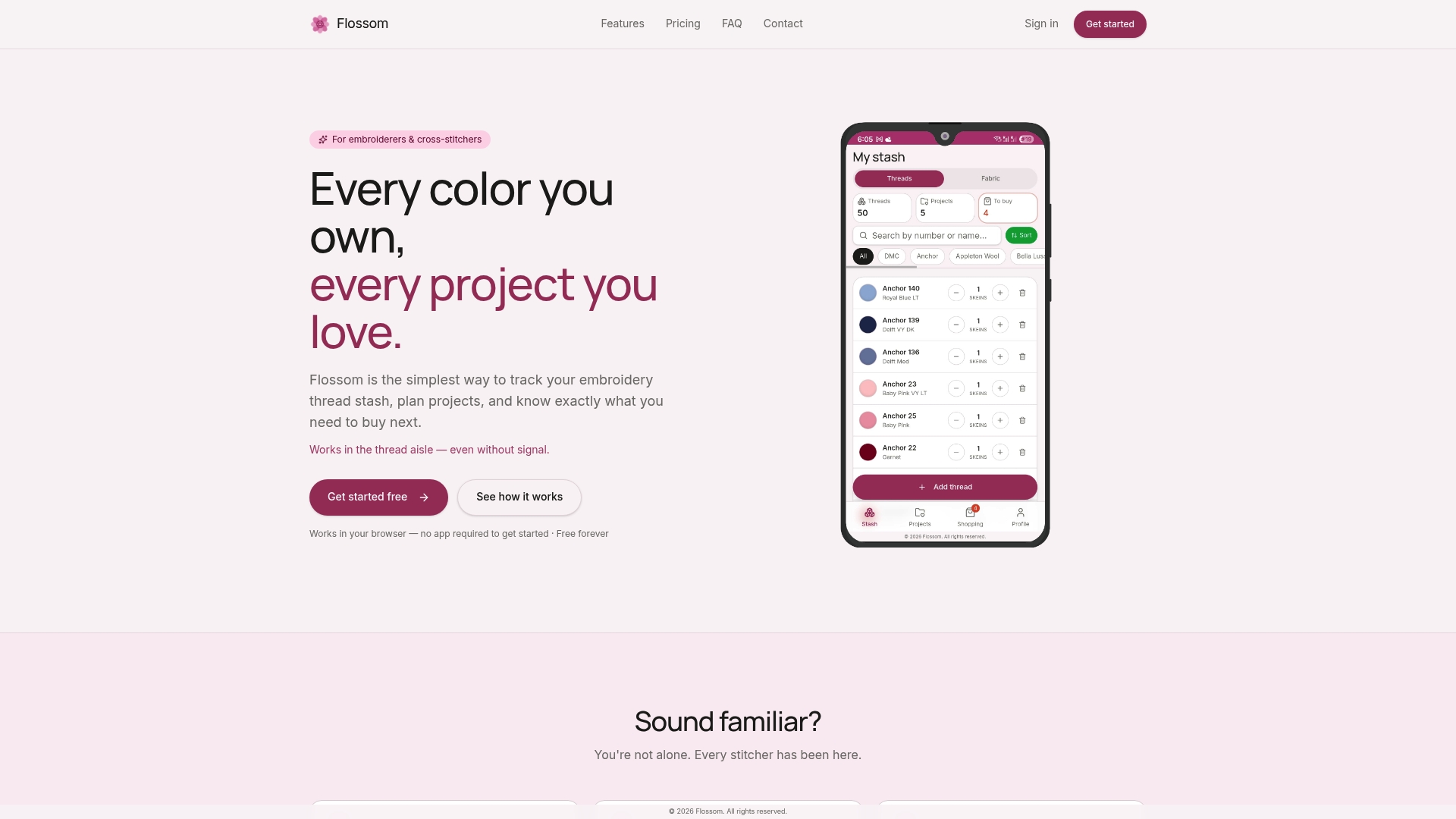
Upload a pattern PDF and Flossom compares its requirements against your stash automatically, generating a shopping list for whatever you're actually missing, whether that's fabric, specific floss colors, or both. The free tier covers unlimited stash tracking and three projects; Pro unlocks additional features such as fabric stash tracking, barcode scanning, and support for more thread brands. If you want to test the sizing math on a real pattern before committing to anything, browse the free pattern library and run one through the calculator to see your options for fabric count firsthand.
Where to Verify These Numbers Yourself
For deeper reference or a second opinion on any figure in this guide, these sources are worth bookmarking:
- A Stitcher's Guide to Cross Stitch Fabric Counts for detailed sizing math across common counts.
- Willow Fabrics' guide to Aida, evenweave, and linen for fabric type comparisons.
- The Cross Stitch Calculator for a quick manual sizing check.
- Flossom's tools and calculators page for fabric and pattern planning in one place.
Sources
- A Stitcher's Guide to Cross Stitch Fabric Counts
- Aida, Evenweave, or Linen: Your Guide to Cross Stitch Fabric
- Cross Stitch Calculator
- Types of Cross Stitch Cloth Fabric - Ultimate Guide to Choosing Cross Stitch Fabrics | Fat Quarter Shop
Recommended
We make Flossom — the calm app for cross-stitchers and embroiderers who want their stash, projects, fabric and shopping list in one tidy place.