Thread Color Conversion Explained: Easy Brand Swaps
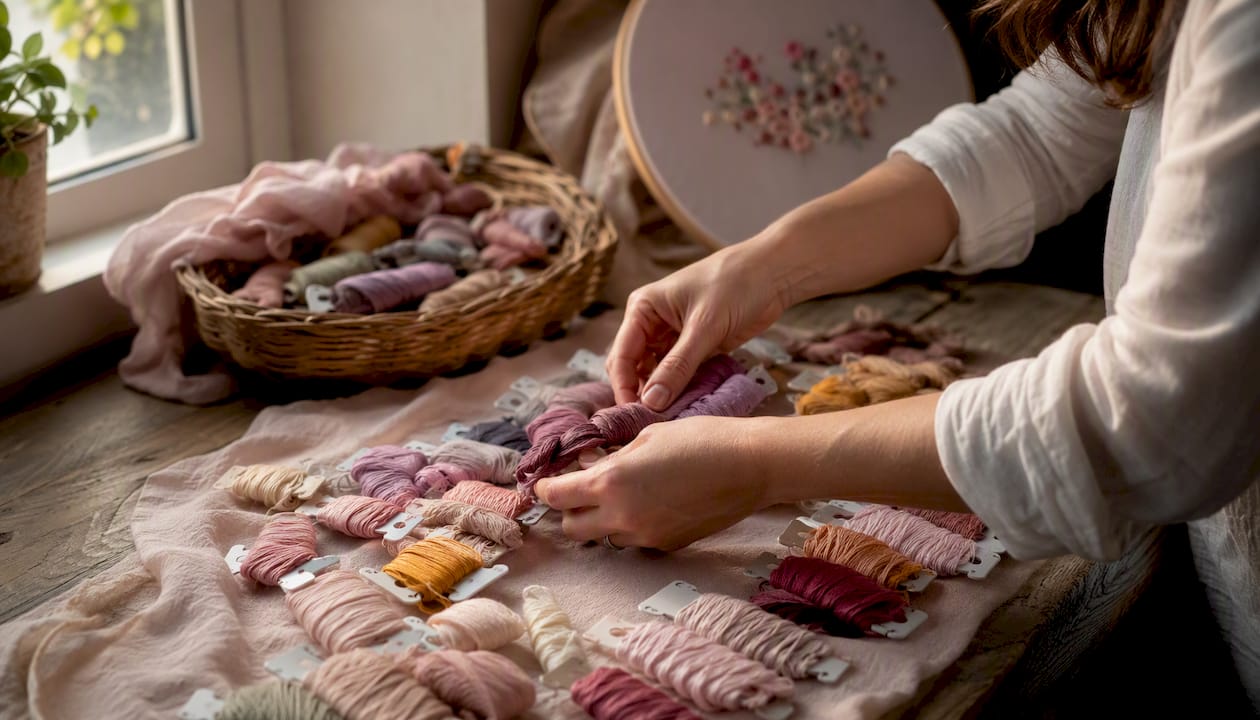
Thread Color Conversion Explained: Easy Brand Swaps ! Hands sorting embroidery threads and charts Thread color conversion is the process of finding the closest usable color code in a different brand's thread line.
Thread Color Conversion Explained: Easy Brand Swaps
Thread color conversion is the process of finding the closest usable color code in a different brand's thread line. You can do it reliably three ways: a printed conversion chart, a Delta E–based digital tool, or a physical swatch test. Most experienced stitchers use all three in sequence.
- Run a converter first to shortlist 2–4 candidates.
- Pull the physical spools and stitch a small sample.
- Check that sample under 5000K daylight before committing.
Pro Tip: Never trust a screen alone. Monitors can shift a thread color noticeably compared to the actual fiber, so a digital shortlist is a starting point, not a final answer.
Table of Contents
- What is thread color conversion and when do you need it?
- What are the three main methods for converting thread colors?
- Variegated, metallic, and other tricky thread types
- Which tools and resources actually speed up thread conversion?
- Key Takeaways
- The part most stitchers overlook
- Flossom makes thread conversion faster from the first project
- Useful sources and further reading
What is thread color conversion and when do you need it?
Thread color conversion maps a specific code from one brand to its nearest equivalent in another. That mapping can be code-to-code (DMC 321 → Anchor 9046) or color-to-code (a hex value or photo → the closest available thread).
You need it more often than you might expect:
- Your pattern specifies DMC, but your stash is mostly Anchor.
- A spool is backordered and you need a substitute fast.
- You want to match a fabric, paint chip, or reference photo to a thread color.
- You prefer a specific fiber type, say rayon for sheen, but the pattern calls for cotton.
- Machine embroidery files arrive coded in one brand while you stock another.
Conversion charts are essential when exact matches aren't available, and the gap between brands is wider than most stitchers expect. DMC and Anchor have been producing parallel color ranges for decades, yet plenty of shades in one catalog have no true equivalent in the other. Knowing that upfront saves a lot of frustration.
What are the three main methods for converting thread colors?
Each method trades off speed against accuracy. Here's how they compare:
| Method | Speed | Accuracy | Cost | Best for |
|---|---|---|---|---|
| Printed conversion chart | Fast | Moderate | Low (one-time) | Quick offline swaps, DMC/Anchor |
| Online Delta E tool | Fast | High (digital) | Free | Multi-brand, batch conversions |
| Visual/photographic match | Slow | Variable | Free–low | Custom colors, photo matching |
Printed charts are shelf-stable and need no internet. A good DMC-to-Anchor chart covers the most common cross-stitch swaps in seconds. The limitation: charts go out of date when brands discontinue colors, and they can't account for fiber or finish differences.
Online converters use CIELAB color space and the CIEDE2000 Delta E standard to calculate perceptual color difference between your input and every thread in a brand's catalog. Tools like Threadcolors.com accept a hex code or image and return ranked matches labeled Excellent, Good, Fair, or Approximate. Thread Color Matcher takes a hex input and returns thread codes and names alongside it. These tools are fast and cover dozens of brands simultaneously. The catch: your screen's color profile affects what you feed in, and neither tool accounts for sheen or texture.
Visual and photographic matching works when you're starting from a photo or a paint chip rather than an existing thread code. A camera color picker samples the dominant hex from an image and passes it to a converter. Useful, but lighting at capture time skews the result. Calibrate your phone camera in consistent light before sampling.
Pro Tip: Use a digital tool to shortlist your top 2–3 candidates, then physically pull those spools and stitch a 1" sample. That two-step process catches the mismatches that screens miss every time.
Variegated, metallic, and other tricky thread types
Standard conversion charts assume solid-color cotton thread. The moment you move outside that, the rules change.
Variegated threads cycle through multiple hues along a single strand. No cross-brand equivalent will match the same color sequence, because the dye intervals differ by manufacturer. Your best option is to find a variegated thread in the target brand with a similar overall palette and accept that the color transitions will fall differently.
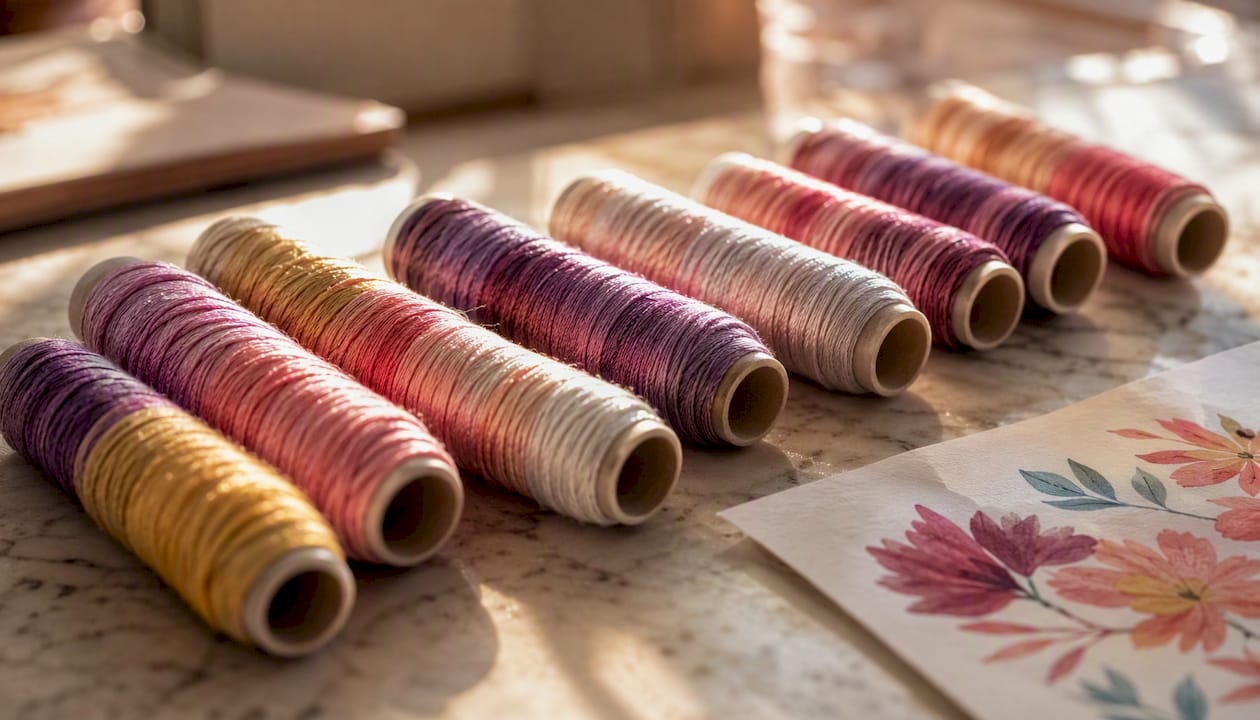
Metallic threads add a reflective layer that changes how the underlying color reads. A gold metallic in one brand can read warm yellow; in another, it reads brass. Delta E tools measure the base color but can't quantify the reflective component. Always swatch metallics.
Fiber and weight differences matter more than most stitchers realize. Rayon has a noticeably higher sheen than polyester, which tends toward matte. Switching fiber types between brands can shift the perceived color by a meaningful amount even when the ΔE score looks acceptable. A 40wt thread also covers fabric differently than 60wt, which affects how saturated the color appears in the finished piece.
Dye-lot variance is a separate issue from brand conversion. Even within a single brand, two spools of the same code from different production runs can differ slightly. Always check the lot number printed on the label, and buy enough thread from one lot to finish a project.
Pro Tip: Keep a small "audition kit": a few inches of each specialty thread type you own, labeled with brand, code, and lot number. When a conversion gets tricky, you can lay candidates side by side on the actual fabric before stitching a single stitch.
A few specific cases worth knowing:
- Neon and fluorescent shades often don't exist in cotton thread form at all. If a pattern calls for a neon, look for the closest saturated equivalent and adjust your expectations.
- Glow-in-the-dark and holographic threads have no meaningful cross-brand equivalents. Treat them as design-specific choices.
- Overdyed threads (hand-dyed, artisan batches) have no numeric code and no converter match. Match visually and swatch extensively.
For more on specialty thread types and how to handle them, the Flossom guide to embroidery specialty threads covers the full range.
Which tools and resources actually speed up thread conversion?
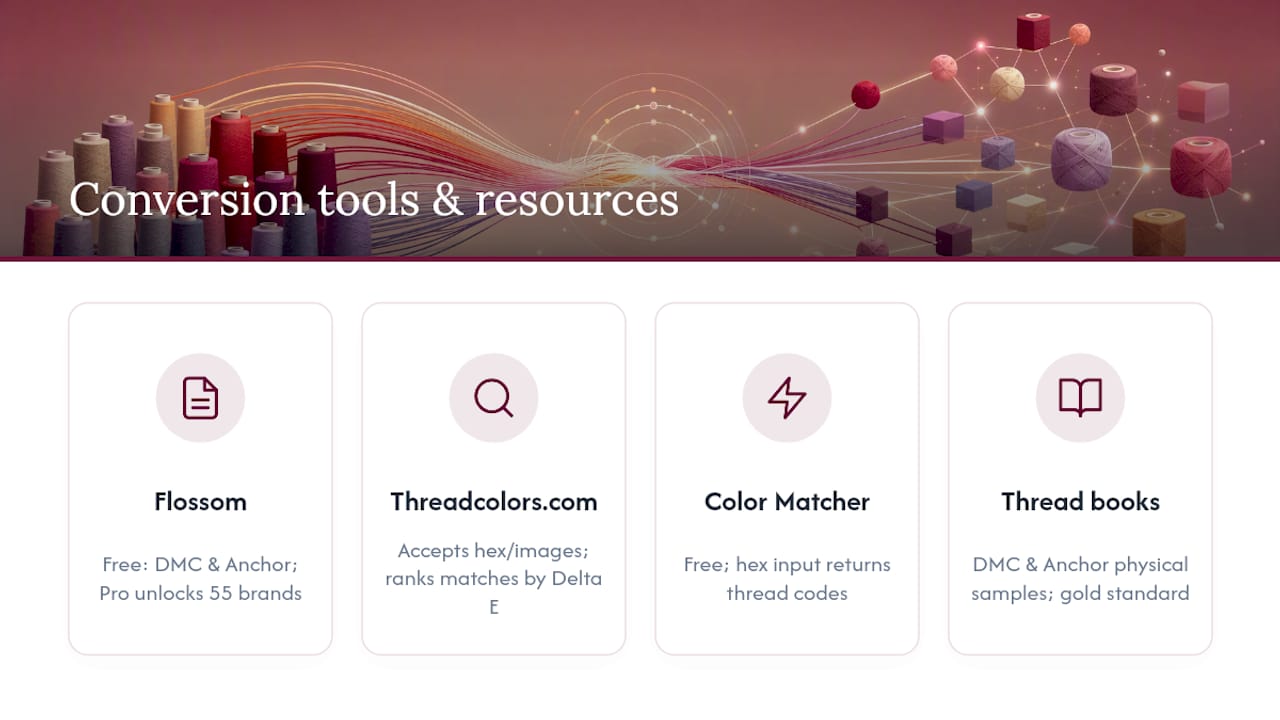
Flossom's thread converter supports 55 brands and integrates directly with your stash catalog. You enter a source code, it returns ranked matches across all supported brands, and it cross-checks those matches against what you already own. If you have a close match in your stash, Flossom flags it before you add anything to a shopping list. The camera color picker lets you sample a color from a photo and feed it straight into the converter.
Flossom's free tier covers DMC and Anchor conversions with unlimited stash entries. Pro unlocks all 55 brands, the camera color picker, barcode scanning, and fabric stash tracking. Everything syncs across devices and exports to CSV.
Threadcolors.com (XStitchify) accepts hex codes or images and ranks matches using Delta E across multiple brands. Good for a quick cross-brand check when you're working from a digital file.
Thread Color Matcher is a free web tool that takes a hex input and returns thread codes and names. Minimal interface, fast results, useful for single-color lookups.
Manufacturer PDFs from brands like Brother are free to download and cover machine embroidery color mappings across supported brands. Worth bookmarking if you do machine work.
Physical thread books from DMC and Anchor remain the gold standard for cross-stitch. No app replaces the experience of holding actual thread against your fabric.
For organizing your stash so conversions stay reliable, the Flossom thread stash organization guide covers labeling, storage, and photographing your collection under consistent light.
Key Takeaways
Thread color conversion works best as a two-step process: use a Delta E tool to shortlist candidates, then verify with a physical swatch under 5000K daylight before you stitch.
| Point | Details |
|---|---|
| Use ΔE thresholds | Aim for low ΔE scores indicating nearly imperceptible differences; higher scores may require a better match or blending. |
| Always swatch | Stitch a 1–2" sample on your actual fabric and check it under both 5000K daylight and final-use lighting. |
| Match by code, not cap color | Thread cap colors fade and vary by dye lot; always use the numeric code for accurate conversion. |
| Specialty threads need extra care | Variegated, metallic, and hand-dyed threads rarely have true cross-brand equivalents; swatch every time. |
| Flossom speeds the process | Flossom's converter covers 55 brands, checks your stash, and auto-generates shopping lists from your pattern. |
The part most stitchers overlook
The conversion tools have gotten genuinely good. Delta E math is solid, the databases are large, and a well-built app can shortlist a match in seconds. But there's a habit that separates stitchers who are happy with their finished pieces from those who aren't, and it has nothing to do with which tool they use.
It's consistency in how they manage their physical stash. Spools organized by code rather than color family. Dye lots written on the label the moment a new skein comes out of the bag. A quick photo of the stash taken under the same lamp every time, so the camera color picker has accurate reference data to work from.
Digital tools speed selection. They don't protect the project. That's what the physical habits do. A monthly stash audit, a spare thread book with actual wraps, and a small audition kit of frequently used shades will catch more problems before they become stitched-in mistakes than any converter ever will.
The other thing worth saying plainly: a "closest match" is sometimes genuinely close enough, and sometimes it isn't. The ΔE number tells you the perceptual gap. Your eye, on your fabric, under your light, is the final judge. Trust it.
Flossom makes thread conversion faster from the first project
If you've been managing conversions with a printed chart and a spreadsheet, Flossom is a faster route to the same result. Enter your pattern's color list, and Flossom's converter checks each code against 55 brands, flags what you already own, and builds a shopping list for what you don't. The camera color picker handles custom colors and photo references. Low-stock alerts mean you won't start a project short on a critical shade.
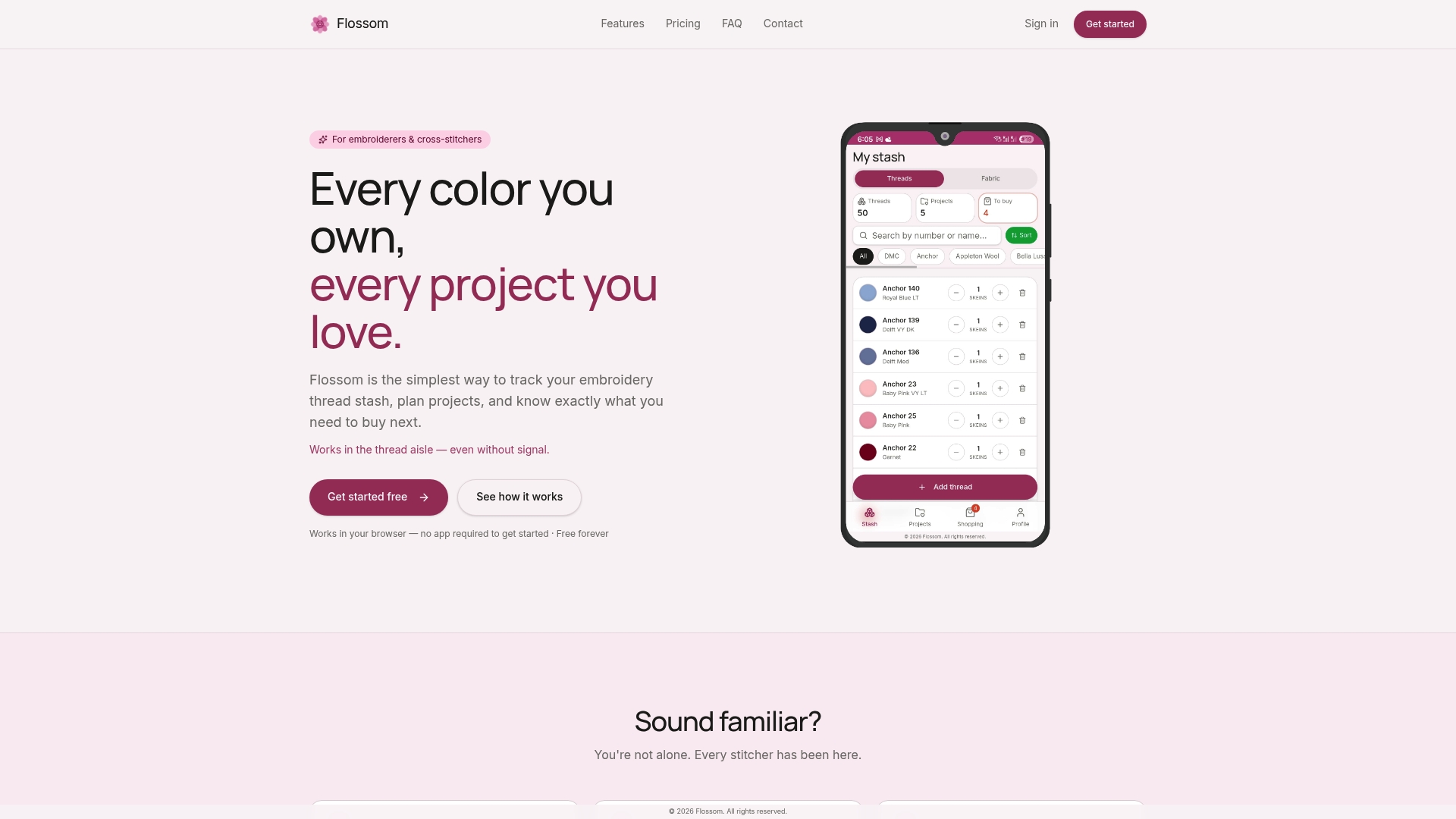
The free tier covers DMC and Anchor conversions with unlimited stash entries and three active projects. That's enough to run a full conversion workflow on most cross-stitch patterns without spending anything. Pro adds the full 55-brand library, barcode scanning, fabric tracking, and unlimited projects. Try the Flossom thread converter and run your next pattern's color list through it before you buy a single skein.
Useful sources and further reading
- Understanding Embroidery Thread Charts - EnS
- Thread Color Chart Guide | Free Converter & Matching Tool
- Thread Colour Converter - Match Any Colour to Embroidery Thread
- Thread Color Matcher
- Thread color conversion chart
- Thread Color Matching Guide: Charts, Tips, and Systems for Embroidery
- Embroidery Color Matching Guide - EnS
- Tools & calculators — Flossom
Recommended
We make Flossom — the calm app for cross-stitchers and embroiderers who want their stash, projects, fabric and shopping list in one tidy place.