How to Convert Embroidery Thread Brands Accurately
Learn how to convert embroidery thread brands accurately, ensuring your designs retain their true colors. Match DMC and Anchor threads effortlessly!
How to Convert Embroidery Thread Brands Accurately
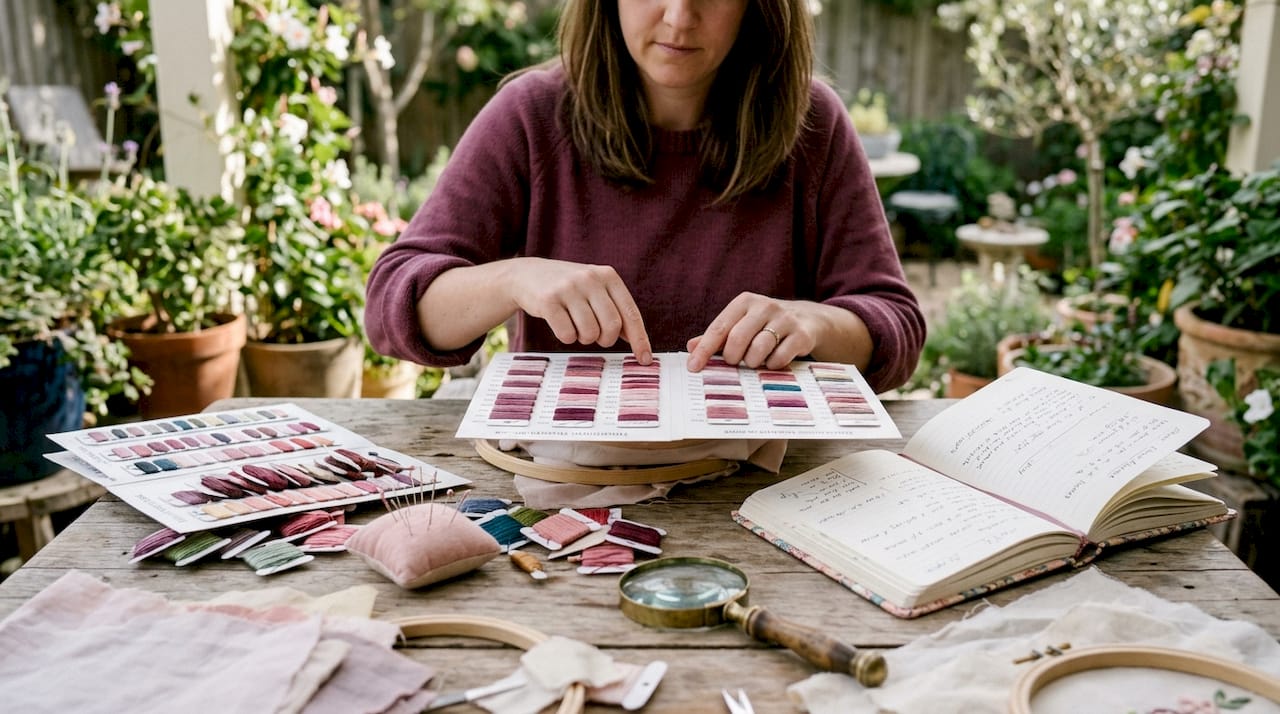
Embroidery thread brand conversion is the process of matching colors across different thread manufacturers to keep your design looking exactly as intended. DMC and Anchor are the two most widely used brands for cross stitch and hand embroidery, with DMC offering around 489–500 solid colors and Anchor around 444–446. That difference matters the moment you pick up a pattern designed for one brand and only have the other on hand. Getting the conversion right requires more than swapping numbers. It means understanding color measurement standards, thread materials, and when to trust your eyes over a chart.
How to convert embroidery thread brands: the foundation
Before you touch a conversion chart, you need to understand what you are actually comparing. Thread brands differ in dye chemistry, fiber content, and finish. Those differences affect how a color reads on fabric, even when two threads share the same numeric code in a conversion table.
Thread material matters more than most crafters expect. Cotton thread, like DMC and Anchor stranded floss, has a matte finish that absorbs light. Rayon and polyester threads reflect light and appear brighter under the same conditions. Substituting a rayon thread for a cotton one in a design built around soft, muted tones will shift the entire mood of the piece. Always confirm the fiber content before finalizing any substitution.
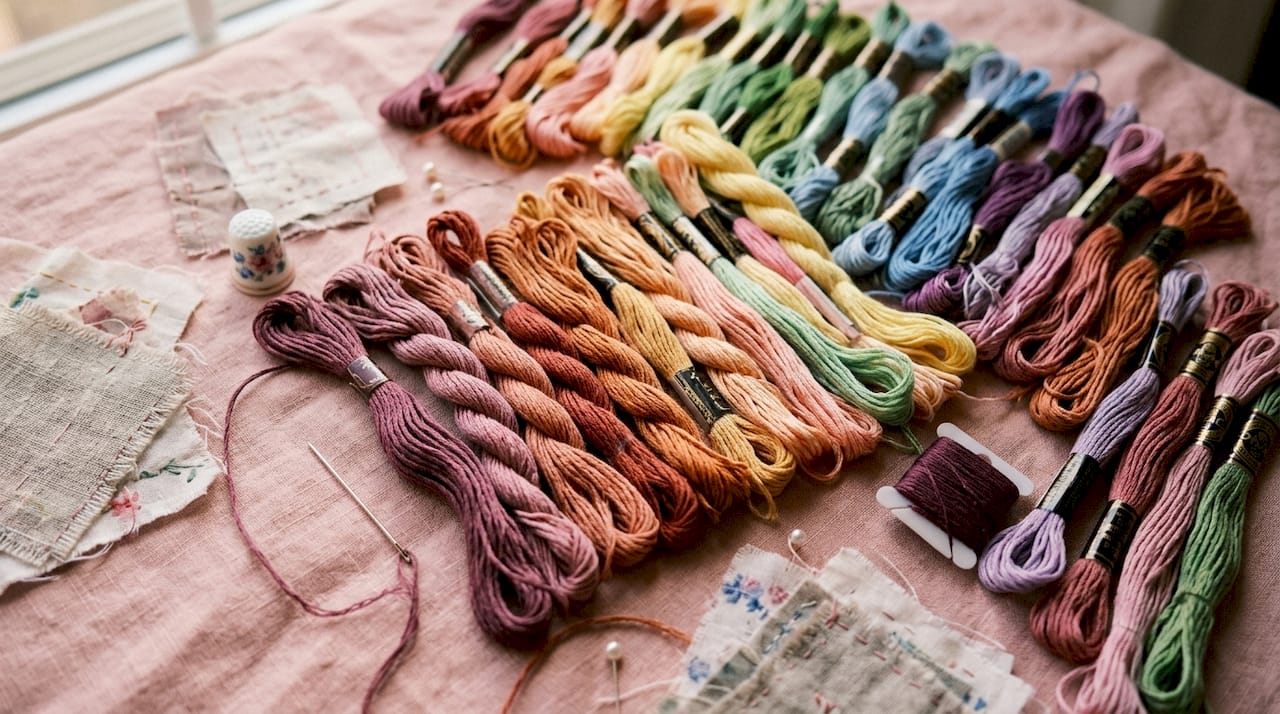
Thread weight is equally critical. Incorrect weight substitution changes stitch density and texture, which can distort the finished design. A heavier thread fills coverage faster, while a lighter thread leaves gaps at the same stitch count. Check the weight specification on both the original and substitute thread before committing.
Your embroidery thread conversion checklist before starting:
- Identify the original brand and color codes listed in your pattern
- Pull the corresponding shade card for the substitute brand
- Note the fiber content and weight of both threads
- Gather a small piece of your intended fabric and stabilizer for testing
- Have a neutral gray card nearby to assess colors under consistent lighting
Pro Tip: Buy a physical shade card for every brand you use regularly. Digital screens introduce a margin of error in how sheen and light reflection appear, and that error compounds when you are trying to match subtle tonal differences.
How do thread conversion charts and digital tools work?
Conversion charts map color codes between brands based on visual similarity and, increasingly, mathematical color difference calculations. Reading one accurately requires knowing that a "match" is rarely a perfect duplicate. About 15% of colors have no exact match between major brands, meaning you will often be choosing the closest available alternative rather than a true equivalent.
Digital tools that apply CIELAB color space calculations give you a more objective starting point. The most reliable standard is CIEDE2000 Delta E measurement, which quantifies the perceptible difference between two colors. A Delta E value under 1.0 is imperceptible to the human eye. Values between 3.0 and 6.0 may be acceptable depending on where the color appears in the design. Values over 10.0 signal a poor match and should be avoided in focal elements.
Here is a quick reference for interpreting Delta E values in thread conversions:
| Delta E value | What it means | Use in embroidery |
|---|---|---|
| Under 1.0 | Imperceptible difference | Safe for any design element |
| 1.0–3.0 | Slight difference, trained eye only | Acceptable for most uses |
| 3.0–6.0 | Noticeable under close inspection | Use in backgrounds or fills |
| Over 10.0 | Clearly different colors | Avoid in critical design areas |
A step-by-step process for using digital conversion tools effectively:
- Enter the original brand and color code into the tool
- Select the target brand from the available options
- Review the Delta E score for the suggested match
- If the score exceeds 6.0, scroll through alternative suggestions
- Cross-reference the digital suggestion against a physical shade card before purchasing
Pro Tip: Flossom's thread conversion tool covers 71 brands and applies color difference calculations automatically, so you see match quality at a glance without manual chart-flipping.
Best practices for testing thread brand conversions on fabric
A digital match is a starting point, not a final answer. The only way to confirm a conversion works is to stitch a test sample on the actual fabric and stabilizer you plan to use. This step catches problems that no chart or calculator can predict.
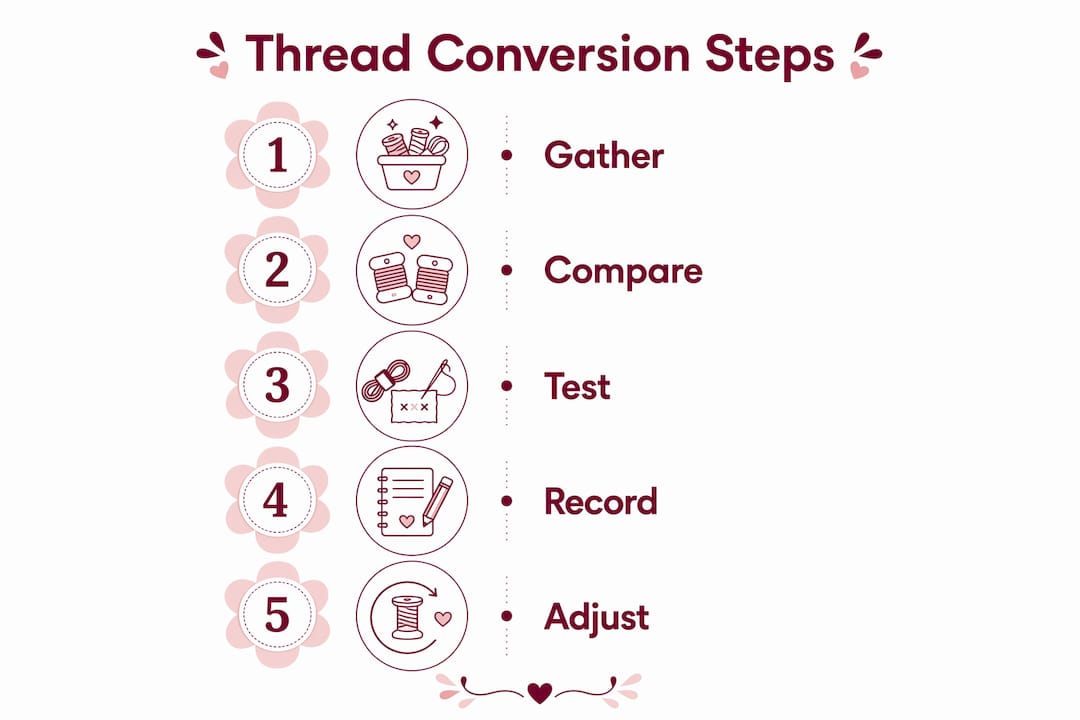
Follow this sequence for reliable testing:
- Cut a small piece of your project fabric, at least 4 inches square
- Stitch a 1-inch block using the original thread color if you have it, then stitch an adjacent block with the substitute
- View both blocks under natural daylight, then under your typical indoor lighting
- Photograph the sample and zoom in to check for color cast differences
- Record the result, noting the brand, color code, Delta E score, and your visual assessment
Lighting changes everything. A thread that matches perfectly under a daylight bulb can shift noticeably under warm incandescent light. If your finished piece will live in a specific environment, test under that lighting condition.
Thread finish affects perceived color as much as the dye itself. A satin-finish rayon and a matte cotton can share the same Delta E score on paper and still look like different colors on fabric because one reflects light and the other absorbs it.
Physical samples remain the most reliable verification method for this exact reason. Screens introduce a margin of error in how sheen and reflection render, and that error is large enough to cause visible mismatches in finished work. Professionals who work across multiple brands keep a swatch journal: a small notebook with stitched samples, brand codes, and notes on how each conversion performed.
Recording your substitutions also prevents repeat work. When you return to a project after a break, a clear record of which thread you used and why saves you from re-testing the same conversion twice.
Common challenges when switching between thread brands
The most frequent mistake crafters make is treating thread conversion as a pure number-matching exercise. Prioritizing numeric code matches over the design role of a color produces technically close substitutions that still look wrong in context. A shadow color and a highlight color can share a similar hue but serve completely opposite functions in a design. Replacing a shadow with a thread that reads slightly lighter shifts the depth of the entire piece.
The most common pitfalls and how to avoid them:
- Over-relying on digital tools alone. Automated tools without manual verification risk color deviation above acceptable thresholds due to thread finish differences. Always test physically.
- Ignoring dye lot variation. Hand-dyed threads have natural dye lot variation, meaning two skeins of the same colorway can differ visibly. Buy enough of a single dye lot to complete your project before starting.
- Mixing thread weights within a project. Even a small weight difference between two brands creates uneven coverage. Stick to one weight standard throughout a single design.
- Failing to plan restocks. Running out of a substitute thread mid-project is a serious problem if the original dye lot was bought from the same batch. Estimate your yardage before you start and buy a buffer.
Pro Tip: Set low-stock alerts in your thread inventory app before you begin a large project. Knowing you are running low on a substitute color while you still have time to reorder prevents the frustration of a mid-project shortage.
Managing your thread inventory proactively also helps you avoid duplicate embroidery thread buys. Crafters who track their stash digitally consistently find they already own a usable substitute for many conversions. Checking your stash before purchasing saves money and reduces clutter.
Cross stitch thread brands compared across a full project can create subtle inconsistencies if you are not systematic. The solution is to convert all colors at the start of a project, test them together on a single sample, and lock in your choices before stitching begins. Changing substitutions mid-project almost always creates visible seams in color transitions.
Key takeaways
Accurate thread brand conversion requires combining color measurement standards, physical testing, and design-role awareness rather than relying on numeric code matching alone.
| Point | Details |
|---|---|
| Delta E guides match quality | Values under 1.0 are ideal; avoid values over 10.0 in focal design elements. |
| Physical testing is non-negotiable | Stitch samples on your actual fabric before committing to any substitution. |
| Design role beats code matching | Assess whether a substitute serves the same visual function, not just the same number. |
| Track dye lots for hand-dyed threads | Buy a full project's worth from one dye lot to avoid visible color shifts. |
| Inventory management prevents shortages | Log substitutions and set restock alerts before starting large projects. |
What I have learned from years of converting thread brands
The single most useful thing I ever did for my stitching practice was buy physical shade cards for every brand I use regularly. I spent years trusting screen-based comparisons and wondering why my finished pieces looked slightly off. The problem was not my eye. It was the screen. A monitor renders thread color without sheen, without texture, and without the way light bounces differently off a satin finish versus a matte cotton. Once I started holding shade cards side by side under natural light, my conversion accuracy improved immediately.
The second lesson took longer to learn. I used to hunt for the closest numeric match and feel satisfied when I found one. What I should have been asking is whether the substitute thread does the same job in the design. A deep burgundy that reads as a shadow in one brand might read as a midtone in another, even at a Delta E of 2.0. The number is a starting point. The design context is the final judge.
My practical advice for crafters working across multiple brands: build a swatch journal. Stitch a small sample every time you test a conversion, note the brand codes, the Delta E score, and your honest visual assessment. After a year, that journal becomes more useful than any chart online. You will have real-world data from your own hands, your own fabric, and your own lighting conditions.
Flossom's supported brands catalog covers 71 thread brands, which means most of the conversions I used to look up manually are now one tap away. That kind of coverage changes how you plan projects, especially when you are working with specialty threads that rarely appear in standard conversion charts.
— Simone
Flossom makes thread brand conversion part of your workflow
Thread conversion is only half the challenge. The other half is knowing what you already own so you do not buy duplicates or run short mid-project.
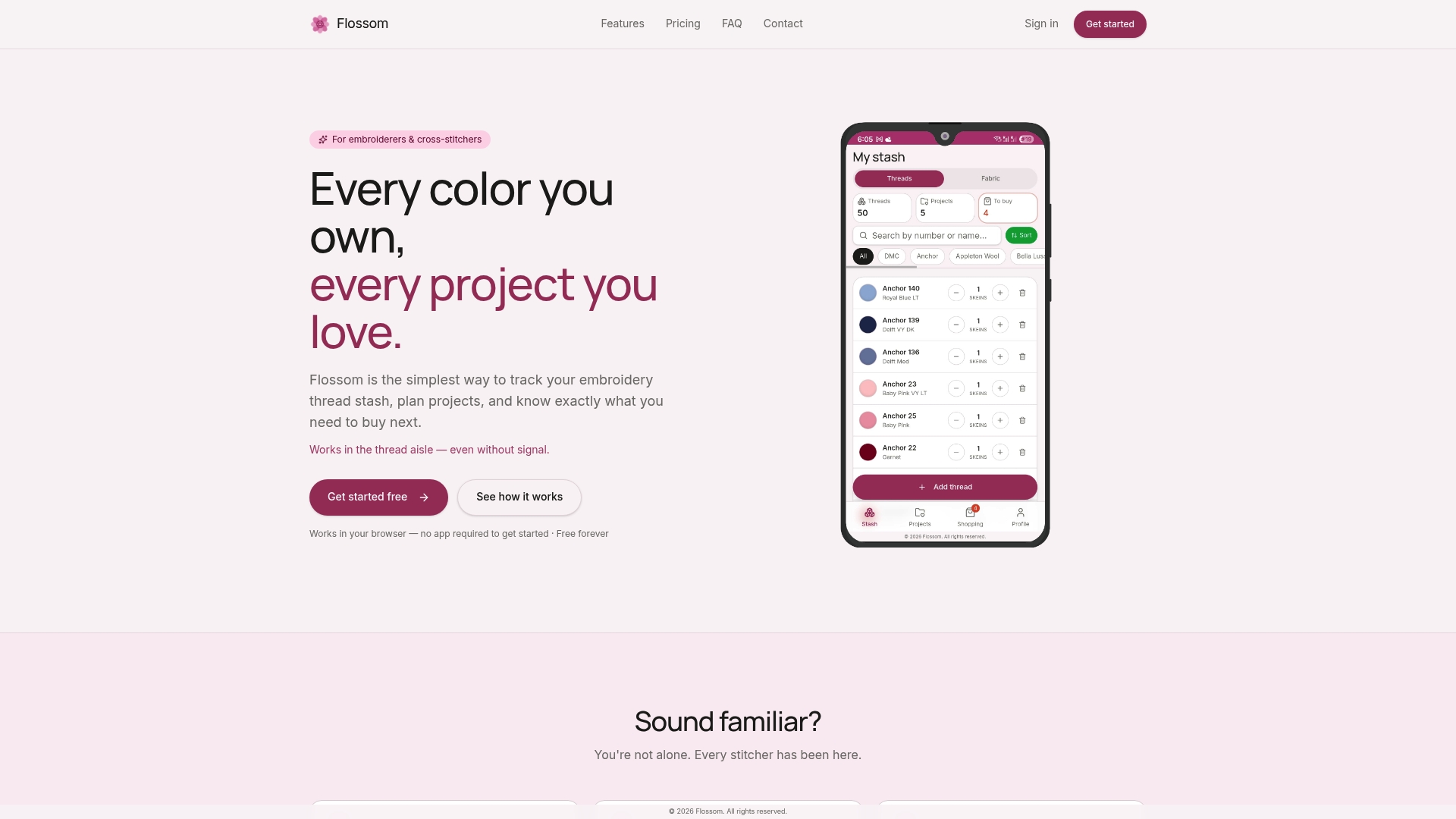
Flossom brings both together in one place. The thread conversion tool covers 71 brands and applies color difference calculations so you find the closest match without flipping through paper charts. Your stash catalog updates in real time, so when a conversion suggests a substitute, you can check immediately whether you already own it. Low-stock alerts tell you when to reorder before a shortage stops your project. The free tier includes DMC and Anchor with unlimited stash entries and three projects. Pro unlocks all 71 brands, a camera color picker, a barcode scanner, and unlimited projects. Start managing your stash and your conversions in one ad-free app that works on any device.
FAQ
What does it mean to convert embroidery thread brands?
Thread brand conversion means finding the closest color match in one brand for a color specified in another. It uses conversion charts or Delta E color calculations to identify the nearest equivalent.
How accurate are thread conversion charts?
About 15% of colors have no exact match between major brands, so most conversions are approximate. Match similarity typically falls in the 92–95% range when a perfect equivalent does not exist.
What is a good Delta E score for thread matching?
A Delta E value under 1.0 is imperceptible to the human eye and represents an ideal match. Values between 3.0 and 6.0 are acceptable for backgrounds and fills but should be avoided in focal design elements.
Why do converted threads sometimes look wrong on fabric?
Thread finish, fiber content, and lighting all affect how a color reads on fabric. A digital conversion does not account for sheen differences between cotton and rayon, which is why physical testing on your actual fabric is always necessary.
How do I avoid running out of a substitute thread mid-project?
Estimate your full yardage requirement before starting, buy a buffer skein, and set a low-stock alert in your thread tracking app. For hand-dyed threads, purchase the entire quantity from a single dye lot before you begin stitching.
Recommended
We make Flossom — the calm app for cross-stitchers and embroiderers who want their stash, projects, fabric and shopping list in one tidy place.