
Yes, DMC Has Discontinued Colors. Here's What to Use Instead
Yes, DMC Has Discontinued Colors. Here's What to Use Instead !
Yes, DMC Has Discontinued Colors. Here's What to Use Instead
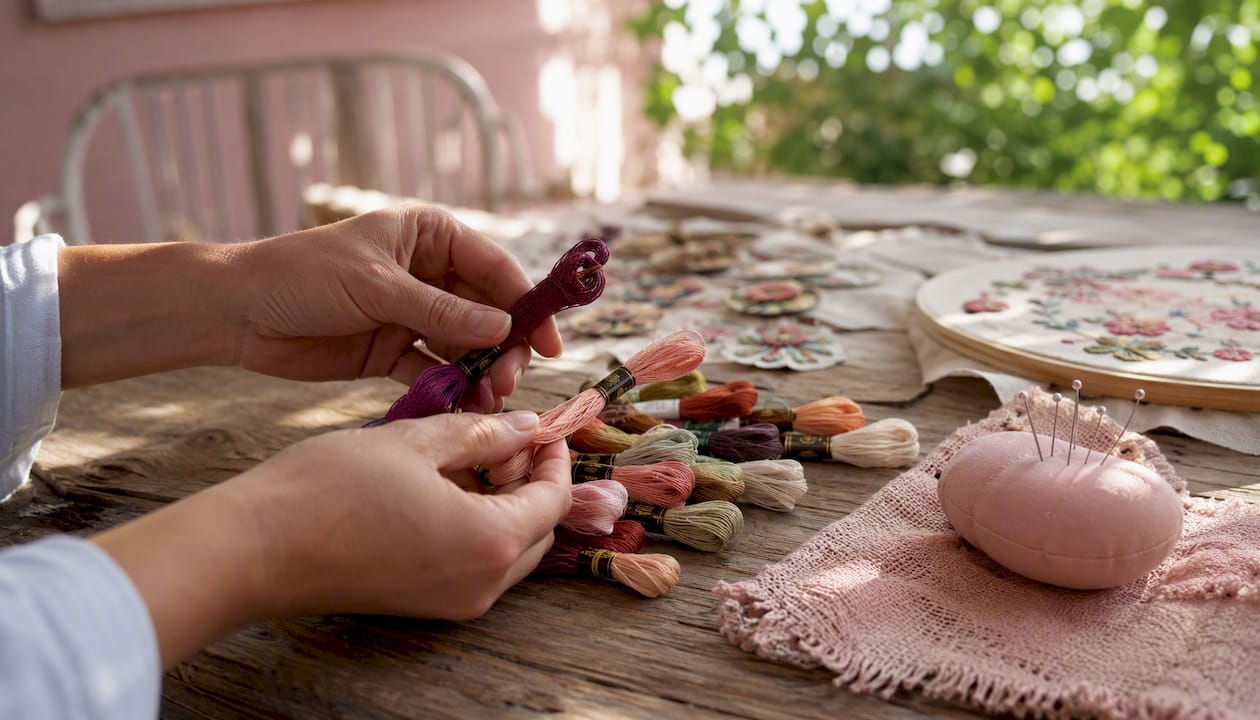
Yes, DMC has discontinued many floss colors over the years, and most have workable replacements. Some cases, such as the 3880–3895 series, DMC 868, and certain metallic and Secret Perfume shades, lack clean substitutes. Use the category tables below to find your exact number, swatch the suggested replacement before committing to a large fill, and log the final choice somewhere you'll actually remember it, like the Flossom stash app.
Do these three things before you touch a needle:
- Find your number in the category tables below and check its listed replacement.
- Stitch a small swatch of the replacement and compare it against your pattern in daylight.
- Record the substitution (original number, replacement, dye lot) so future projects stay consistent.
Quick fact: the most disputed discontinuation isn't a single color at all. It's an entire block of numbers, the 3880–3895 range, that never appeared on standard DMC color cards outside the US and got revised replacement guidance as recently as 2023.
Key Takeaways
Most discontinued DMC colors have a documented replacement, but the 3880–3895 series, 868, 724, and 974 require extra care because their substitutes are either revised, contested, or nonexistent.
| Point | Details |
|---|---|
| Swatch before committing | Stitch a small test swatch and check it under two light sources before filling a large area. |
| Watch the 3880–3895 series | This block was excluded from standard color cards and got revised replacement guidance in 2023. |
| No replacement exists for some numbers | 724 and 974 have no official substitute; blending two colors is the common workaround. |
| Match dye lots within a fill | Buy all replacement skeins in one purchase to avoid visible shading differences in large areas. |
| Log every substitution you make | Flossom lets you tag a discontinued number with its replacement, a swatch photo, and a low-stock alert. |
Table of Contents
- Complete List of Discontinued DMC Colors by Category
- How Do You Pick the Right Replacement Color?
- Where Can You Find Discontinued DMC Skeins?
- What Are the Most Confusing DMC Discontinuations?
- How Do You Label and Track Discontinued Thread Substitutions?
- Can a Stash App Actually Solve This Problem?
- Keep Your Thread Substitutions Consistent With Flossom
- Frequently Asked Questions
- Sources
Complete List of Discontinued DMC Colors by Category
DMC doesn't publish a single, permanent "discontinued" master list. Colors disappear quietly when a dye becomes hard to source, a shade underperforms in sales, or a whole subline gets phased out, and DMC's own communication about it is thin. Most of what the embroidery community knows comes from cross-referencing what's still orderable against older color cards and pattern keys, then comparing notes.
That gap is exactly why community-maintained references matter. The most complete public record remains Lord Libidan's discontinued thread list, which tracks discontinuations going back to the 1950s alongside suggested substitutes. Cross-checking it against Craft with Cartwright's era-grouped list is a smart habit, since the two occasionally diverge on a replacement number and agreement between them is a good confidence signal.
Solid colors
These are individual, single-tone florals that got pulled from the standard line at various points, some as far back as the 1950s and 60s.
Variegated colors
Variegated florals are harder to replace cleanly because the replacement needs to match a whole gradient, not one flat tone. Fewer of these have official substitutes, so swatching matters even more here.
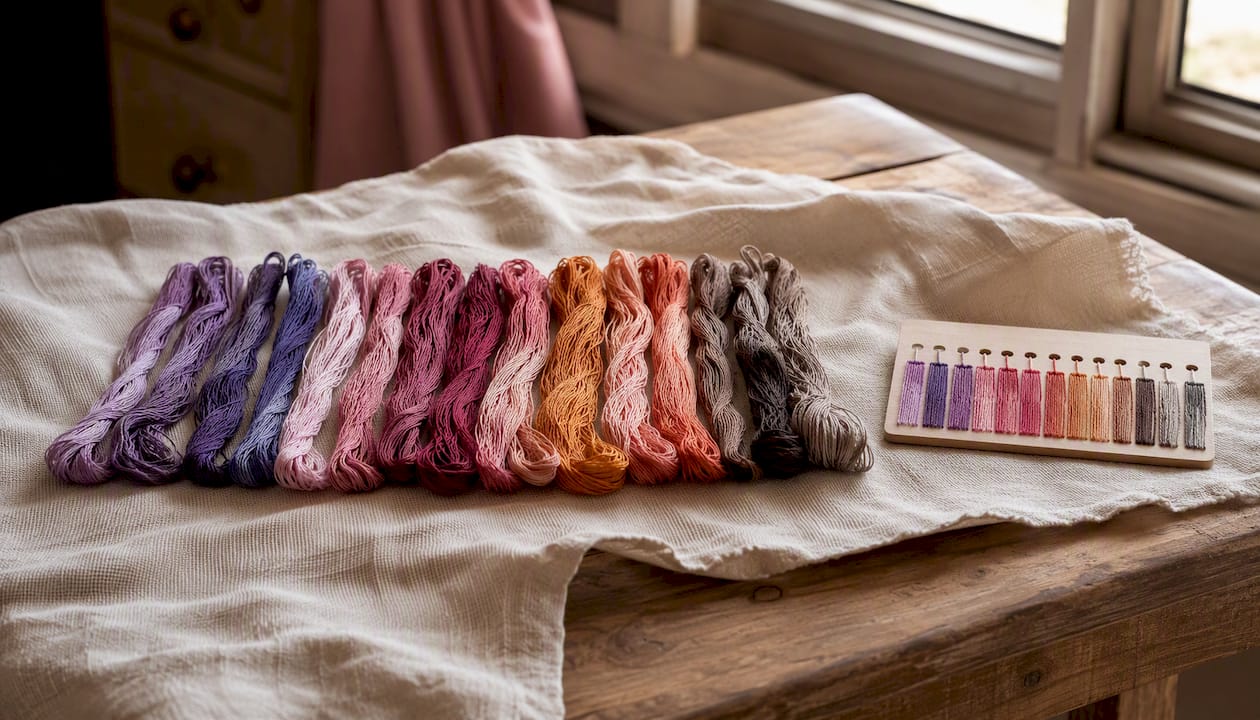
| Number | Name | Replacement | Discontinued | Notes |
|---|---|---|---|---|
| — | Variegated Rose | Check current variegated line | Older discontinuation | No exact match; closest gradients run warmer |
| — | Variegated Golden Olive | Check current variegated line | Older discontinuation | Compare gradient spacing, not just color |
The 3880–3895 metallic-adjacent series (2013)
This block deserves its own table because it's the single biggest source of confusion in DMC's discontinuation history. The whole run was effectively US-only, excluded from standard color cards due to dye and regulatory issues in some markets, then discontinued around 2013.
Metallics (E-series / Light Effects)
Metallic floss ages differently than cotton. Old skeins tarnish and fray, so a "discontinued" number here is often a condition problem as much as an availability one.
| Number | Replacement | Discontinued | Notes |
|---|---|---|---|
| — | Check current Light Effects line | Older discontinuation | Compare filament thickness, not just hue |
| — | Check current Light Effects line | Older discontinuation | Newer metallics run slightly less brassy |
Rayon and Secret Perfume (SP…) colors
DMC's rayon line and the scented Secret Perfume (SP) series were both niche and short-lived, which means replacement data is thinner than for mainline cotton floss.
| Number | Replacement | Discontinued | Notes |
|---|---|---|---|
| — | No confirmed replacement | Discontinued | Sheen alone makes cotton substitutes look flat |
| SP series (assorted) | No official replacement | Discontinued | Scent was the selling point; color match is secondary concern |
A few things worth flagging before you move past these tables. First, 724 and 974 have no official replacement documented, full stop, so budget extra time for testing blends if your pattern depends on them. Second, the 868/3882/3884 cluster trips up even experienced stitchers because all three sit in the same brown-gold family; treat them as three separate decisions, not one. Third, if you're managing more than a handful of substitutions, exporting your findings to a CSV and importing them into a stash organization tool beats a sticky note taped to your project bag.
How Do You Pick the Right Replacement Color?
Swatch first, always. A color that looks perfect on a screen or a printed color card can read completely differently once it's stitched at your fabric count under your lighting, and the only way to know for sure is to put thread through fabric before committing to a full fill.
Here's the sequence that actually catches mismatches before they become a ripped-out section:
- Stitch a small test swatch, roughly 3x3 or 5x5 stitches, on a scrap of the same fabric and count you're using for the project.
- View it under two light sources: natural daylight near a window, and whatever lamp you'll actually be stitching under at night. Colors shift more than you'd expect between the two.
- Photograph the swatch next to the original color if you have a reference skein, then zoom in on the photo to check undertone and sheen side by side.
- Check for sheen mismatches, especially with metallics and rayon substitutes, since a matte cotton replacement can look flat next to the original's shine.
Sometimes a straight swap isn't close enough, and that's when blending two strands earns its keep. For 3882, some stitchers find 801 alone runs a touch too red and blend it with a single strand of 3862 to cool it down. For 3892, DMC's 2023 replacement update settled on 970, which most stitchers find works fine solo, no blending needed. For 724, since there's no official match, a common workaround blends 3855 and 745 to approximate that bright apricot without going too yellow or too pale.
Pro Tip: Label every swatch with the dye lot number, not just the color number. Dye lots vary enough between production runs that two skeins labeled "801" bought a year apart can look slightly different in the same fill. If you're stitching a large background area, buy all your replacement skeins in one purchase and stick to that single dye lot for the whole section.
Where Can You Find Discontinued DMC Skeins?
Check specialty needlework shops first, then stitcher swap groups, then general marketplaces last. Small independent cross-stitch shops sometimes have old stock sitting in drawers that never made it into their online inventory, and a quick email or call can turn up a discontinued number you thought was gone for good.
Beyond that, here's where the community actually finds these threads:
- Independent needlework retailers that have carried DMC for decades often have leftover stock of older numbers.
- Online marketplaces like Etsy and eBay carry vintage lots, though quality varies wildly seller to seller.
- Stitcher swap groups on Facebook and Ravelry are often the fastest route for a single skein of something obscure.
- Destash sales from other crafters clearing out old stashes turn up surprisingly deep cuts.
Before you buy secondhand, check for fading (hold the skein against a white background), brittleness in metallics (a stiff, crackly feel means it's degraded), and any smell if you're hunting a Secret Perfume number, since scent fading is common and expected with age. Ask sellers for a close-up photo in natural light, and be wary of listings where the skein band doesn't match known DMC packaging conventions for that era, since mislabeled or counterfeit skeins do circulate.
What Are the Most Confusing DMC Discontinuations?
The 3880–3895 group causes more confusion than any other batch, largely because it was never properly documented in the first place. These numbers were pulled from standard color cards outside the US due to dye and regulatory issues, which means half the embroidery world never saw them listed as active in the first place, let alone discontinued.
The 868/3882/3884 trio causes the second most confusion, and it's a naming problem more than a color problem. All three sit in a similar brown-gold zone, and older pattern keys sometimes list one where a newer key lists another, leading stitchers to assume they're interchangeable when they're not quite.
DMC rarely issues a clear public announcement when it drops a color. Most of the time, the community only figures it out when a number quietly disappears from the current color card, and third-party lists become the closest thing to an official record.
A few myth corrections worth remembering:
- Don't assume a number printed in an older pattern is still available just because the pattern itself is still for sale.
- Don't trust a replacement number from a five-year-old blog post without checking a current list, since DMC has revised guidance before, most notably for the 3880 series in 2023.
- Don't assume every discontinued color has a replacement at all. 724 and 974 don't.
How Do You Label and Track Discontinued Thread Substitutions?
Label now, save time later. The single biggest cause of mismatched projects isn't a bad color match. It's forgetting which replacement you used six months ago when you pick the project back up.
A workable record needs five fields: the original number, the replacement number, the dye lot, a swatch photo, and a one-line note on match quality (exact, close, or blended). Keep that record per project, not just per skein, since the same discontinued number might get a different replacement in two different patterns depending on the surrounding palette.
A simple checklist covers most of it:
- Photograph the swatch next to the pattern's color key before you start stitching the full area.
- Note the dye lot on the skein label or a sticky note tucked into your project bag.
- Record any blended recipe (like the 801 plus 3862 mix mentioned earlier) so you can recreate it exactly if you run out.
- Tag the project so you can find the substitution again if you stitch a similar pattern later.
Can a Stash App Actually Solve This Problem?
Use a stash manager to record discontinued numbers and their chosen replacements, because a spreadsheet you forget to open doesn't help you six months into a project. The practical fix is building that record into whatever tool you already use to track your thread stash, so the substitution surfaces automatically the next time it matters.
In Flossom, the workflow looks like this: photograph your test swatch, tag it with the original discontinued number, set the replacement you've chosen, and turn on a low-stock alert so you're never caught short mid-project. The features that matter most for this specific headache are DMC catalog support, CSV import and export for your own research lists, pattern PDF upload so the app knows what a project actually calls for, and photo attachments so every swatch decision has a visual record attached to it.
- DMC and Anchor catalog support built into the free tier.
- CSV export so your substitution research travels with you.
- Photo swatch attachments tied directly to each thread entry.
- Low-stock alerts that catch a shortage before it stalls a project.
Pro Tip: Name your replacement entries with both numbers and a swatch reference, like "3892 → 970 (replacement; swatch A)." That naming convention shows up clearly in exported shopping lists, so you're never guessing which skein you meant three projects later.
A note on testing these replacements firsthand
When I swatched 3880 against its listed replacement, 3722, the match held up fine under daylight but ran slightly warmer under lamp light, which is a small enough gap that most stitchers wouldn't notice unless they'd seen the original side by side. That kind of small, controlled swatch test is exactly how the replacement recommendations in the tables above earned their place: not by trusting a chart alone, but by putting thread next to thread first.
Keep Your Thread Substitutions Consistent With Flossom
If you want your replacement choices to stay consistent from one project to the next, log them in Flossom instead of a sticky note or a memory you'll lose track of. The app catalogs your DMC and Anchor stash for free, so every discontinued number and its chosen substitute lives in one searchable place instead of scattered across old pattern printouts.
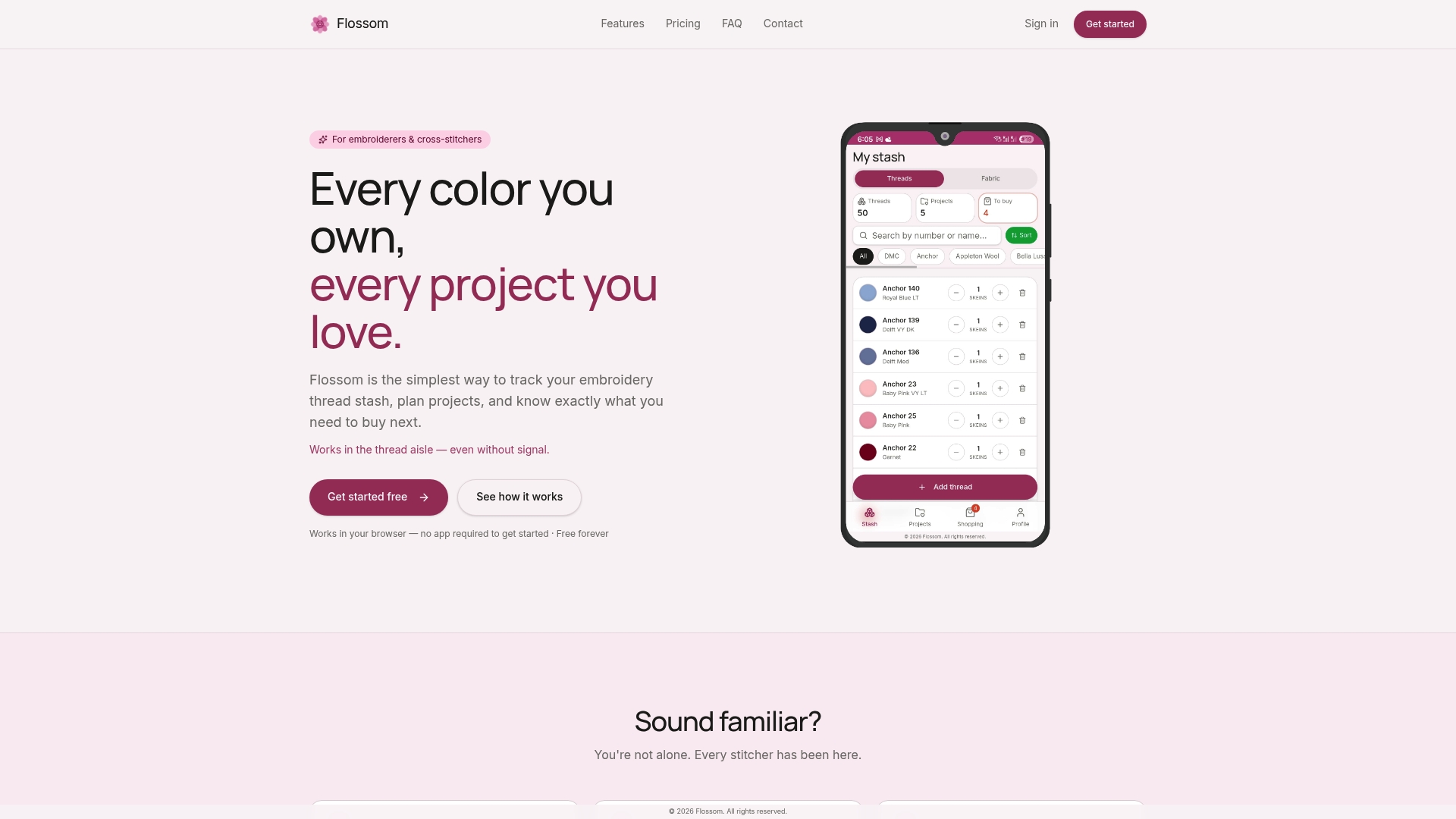
Three things make this worth setting up before your next project: it builds a shopping list automatically by comparing what a pattern needs against what's already in your stash, it stores a photo of your swatch test right next to the color entry so you're not relying on memory, and it flags low stock before you run out mid-fill. If you're also trying to estimate how long a project with substituted colors will take to finish, the project time calculator is a useful companion for planning around any extra swatching time. Start with the free tier, which covers the full DMC catalog and unlimited stash tracking, and see how it handles your next discontinued-color decision.
Frequently Asked Questions
Does DMC still make all the colors shown on old pattern charts? No. DMC discontinues numbers periodically, and older pattern charts often reference colors that are no longer in production, so it's worth checking a current list before you shop for a pattern's exact numbers.
Is there always a replacement for a discontinued DMC color? Not always. Most discontinued shades, including the entire 3880–3895 series, have a documented substitute, but a handful of older numbers, like 724 and 974, have no official replacement and require a blended workaround.
Why did DMC discontinue the 3880 through 3895 series? That block was largely excluded from standard color cards outside the US due to dye and regulatory issues, and DMC discontinued it around 2013, later revising some of the recommended replacements in 2023.
Where can I buy a DMC color that's been discontinued? Independent needlework shops, stitcher swap groups, and online marketplaces are the most reliable sources, though secondhand skeins should always be checked for fading, brittleness, and packaging that matches known DMC conventions.
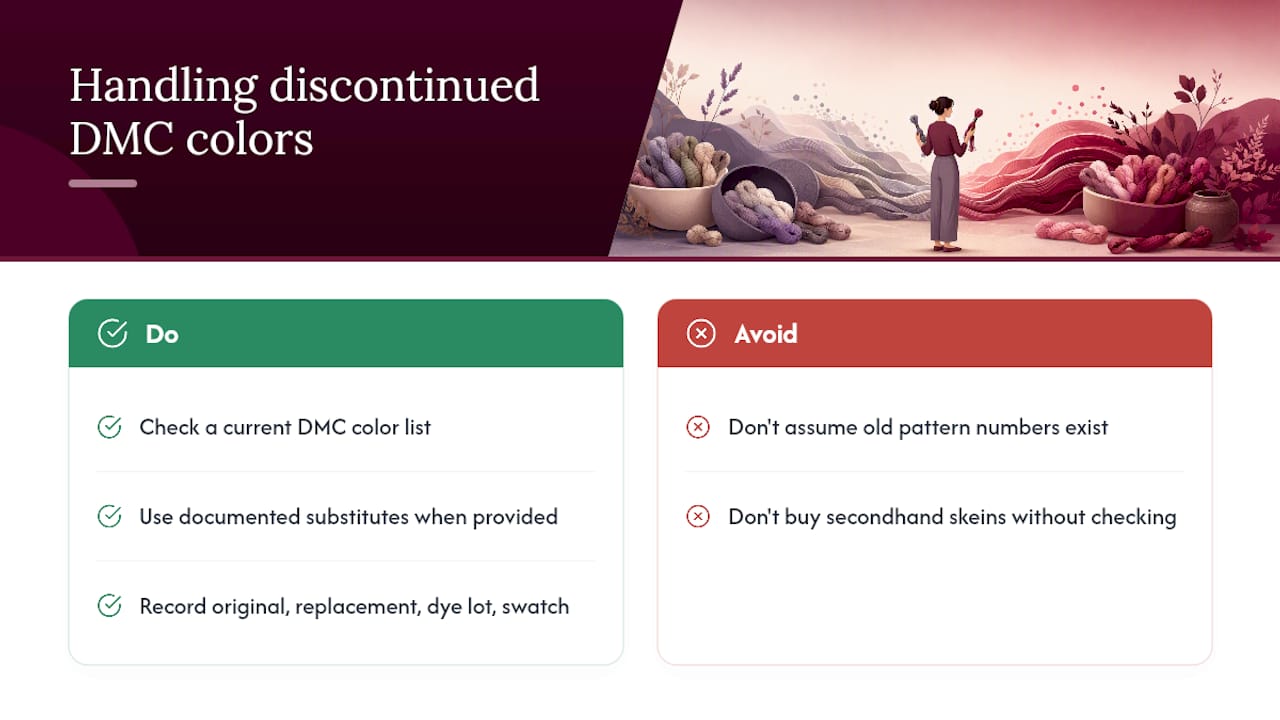
How do I keep track of which replacement I used in a project? Record the original number, the replacement number, the dye lot, and a swatch photo for each substitution, ideally in a stash app like Flossom so the record stays attached to the project instead of a loose note.
Sources
- Full Official List Of Discontinued DMC Threads
- DMC discontinued floss list and replacements *updated - Craft with Cartwright
- DMC Color Variations
Recommended
We make Flossom — the calm app for cross-stitchers and embroiderers who want their stash, projects, fabric and shopping list in one tidy place.